

VeeFriends Issue 20 is the first issue in the series to expand to a print run of 20,000 copies. Every copy was released inside a blind-bagged Collector's Comic Pack, with increasingly rare cover treatments, original sketches, a Gold /10 and a Lollipop 1-of-1 hidden throughout the release. Before the story even begins, the physical comic is already built around collecting rarity.
That makes Big Game Bandicoot an especially interesting character to place inside it. Before this comic, his official VeeFriends character page presented him as a straightforward sports hero: a star quarterback, an MVP and the player who always comes through when the game is on the line. His slogan is “Play BIG, or go home!” Even his competitive advantage sounds controlled. He knows how to play smart by balancing bold moves with calculated decisions. He was competitive, but that competition was presented as leadership.
This comic keeps almost every part of that description and changes what it means. Big Game is still the athlete who performs under pressure, studies the arena, and finds a way to win. But always coming through becomes an inability to remain defeated. Playing big becomes a need to find a bigger game. Calculated decisions become the steps he takes toward hunting living creatures. The issue doesn't argue that wanting a rare comic is the same as hunting a living being. It's interested in the line between admiring rarity and deciding that rarity belongs to you. That's a sharp tension for a blind-bagged collectible comic whose own rarest copy can belong to only one person.
The celebrity-interview framing puts that tension to work before the story even opens. The standard comic cover doubles as the cover of Winner Winner Magazine, the feature this interview is creating. That means the first image we see is already the polished public version of Big Game's story, complete with “How To Win At Everything. At All Costs!” Big Game isn't introduced by an enemy or a detective. He's allowed to tell the story of his own success, inside the private room where he keeps the proof. The interview gives him control over what his achievements mean while quietly placing his trophies, his language and his version of events in front of us as evidence. We're meeting the public hero and the subject of an investigation at the same time.
That investigation began at the end of Issue 19, when Agent Cane recruited Moral Monkey to investigate VeeFriends being targeted and showed him the missing Elegant Elk. It now takes us to Sydney, where an interviewer and cameraman are sitting down with one of the last people to see Elk alive. The scene looks like a rare celebrity profile. The previous issue gives us reason to suspect it's something else before the identities behind the interview are revealed.

The first panel of VeeFriends Issue 20 appears to show us the visually iconic Sydney Opera House, with the Sydney Harbour Bridge behind it. This would place our story in Sydney, Australia.
The woman conducting the interview in the next panel bears a striking resemblance to Agent Cane from Issue 19. We know Cane is a secret MI5 agent who specializes in disguises and deception, so I immediately have to wonder whether she is already undercover again. That also raises the question of who the photographer with her might be.
Beginning the interview, she asks Big Game Bandicoot about the secret to his success. “Easy!” he answers. “In life, believe it or not, you can have it all. Or in my case, win it all.”
For Big Game, winning it all starts with believing in yourself, but not in any normal way. He says you need to become obsessed with that belief.
His answer then gives way to the large title at the bottom of the page, making the interview feel like the opening narration to The Bold Adventures of Big Game Bandicoot.

Turning the page, we enter an enormous trophy room filled with gold cups, ribbons, swords, guns, a mounted marlin, and even a rubber duck sitting on the cabinet. The sheer scale makes Big Game look even smaller as he stands in the bottom corner with his cane and drink. Two purple-and-gold trophies shaped like lowercase e’s stand on the shelves at the far right. What did Big Game win those for?
Continuing his answer, Big Game says the key to his success is knowing what he wants and going after it. The interviewer is impressed, especially because he does not normally grant interviews or show anyone this room.
When Big Game answers her next question, he finally gives us the interviewer's name: Mandy. After her resemblance to Agent Cane already caught my attention, that name makes the connection even harder to ignore. Mandy rhymes with Candy, and Candy Cane is Ben's childhood friend who revealed herself as an MI5 agent in Issue 19.
Big Game goes on to explain that he does not care for fame and values his privacy more as he gets older. The chance to appear on the cover of Winner Winner Magazine, however, was a bucket-list item he could not pass up.
That also explains the cover of the comic itself: this interview is the feature that puts Big Game on the cover of Winner Winner Magazine. The Winner Winner cover is dated June ’26, giving the magazine feature its clearest place on the story’s timeline. The esports check we later see is dated 5/5/25, so Big Game’s flashback reaches back more than a year before the magazine feature.

Before the interview continues, there is one ridiculous detail we cannot ignore: the olive in Big Game's martini looks bigger than the glass and almost bigger than his head.
Once we get past that enormous olive, Big Game tells Mandy no questions are off-limits and calls himself an open book. Mandy takes him at his word, first calling him a real winner and addressing him as Mr. Bandicoot.
Big Game quickly corrects her: “Please, call me Big Game.” He wants the nickname, not the family name, which leads directly into Mandy's next question about how much that family name has shaped his success.
She asks how he feels about people who say what he really won was being born into a rich family that opened every door for him. Some even call him a trust fund baby.
Instead of answering her directly, Big Game keeps smiling, but his eyes narrow as he responds, “Ah... you mean my haters?” He invited Mandy to ask anything, and the first difficult question has already put him on the defensive.

Big Game says he doesn't think about his “haters” at all, but he does answer the point underneath Mandy's question. Yes, his family is filthy rich. To some people that would sound like a dream; to him, he says, it was something he hated. He hadn't earned the money, so it never really felt like his.
The portraits show his family, while the butler standing nearby with a drink hints at the privileged life Big Game was meant to inherit. His family wanted him to carry on the business; he wanted to make his own way.
For Big Game, that meant rugby. He describes himself as a natural athlete, small and nimble enough to avoid danger, and says he became the best rugby player in the world.
When Mandy asks why his family didn't approve, Big Game says they didn't want him to get hurt. “And then, you did get hurt,” she replies.

Big Game and Elegant Elk charge down the rugby field together. Big Game says his skills helped lead them to world championships many times over. He leads with his own talent, but tells the championship story as something he and Elegant Elk did together. Around that run, the page shows the rewards piling up: a branded shoe, a cereal box, and stacks of cash. The brand deals alone, he says, were very lucrative.
Soon Big Game was making more money than his family. “This felt like a real win for me,” he says. That word, “real,” carries the contrast with the money he was born into: it was not the amount alone he cared about, but having earned it through the career he chose.
Mandy brings him back to the injury. She asks if Big Game thinks he was targeted, and he says he now knows without a doubt that he was. When she asks how it happened, Big Game begins with their fifth championship game in a row. He says it was business as usual: he and Elegant Elk were crushing their opponents.

Big Game’s memory of the championship game shifts from confidence to fear before anyone is hit. He says a feeling he has never known comes over him: dread, imminent danger. It plays like Spider-Man’s Spider-Sense: trouble registers before Big Game can see where it is coming from. His eyes are wide as he looks over his shoulder while the game continues around him. Why would Big Game have a warning sense like that, and why is this the first time he has felt it?
On the field, Big Game has no clear path to score, but Elk does. He quickly passes Elk the ball and believes they are about to win again.
Then Elk sends the ball back. Big Game says he cannot believe what he is seeing from the teammate who shared all those championships with him. Elk still has a clear route, while Big Game is facing oncoming opponents and is not ready for the return.
The opposing players crash into Big Game and pile on top of him, crushing and injuring him while Elk stands farther back. The final panel contains only Big Game’s words: “And then everything went black.”

Big Game wakes in the hospital with his leg trashed. He says he will never be able to compete physically again. His cousin Buckley opens with, “We hate to say we told you so, dear cousin,” then asks whether Big Game has gotten rugby out of his system. The family has serious matters to discuss.
“It’s over for me, Buckley,” Big Game says. Buckley suggests that he can still compete in business, as if that could replace what just happened on the field. He calls him Bobby, and Big Game immediately corrects him: “It’s Big Game. My name is Big Game, not Bobby.” Buckley says the family business is in trouble and needs Big Game’s competitive spirit. “It’s all up to you now.”
Big Game demands to know what he means, and Buckley tells him his parents are missing. Their plane may have crashed deep in the jungle, but it was never recovered. The large panel beneath their conversation shows it burning above the trees. His parents had wanted him to join the family business. Now they are missing. Buckley expects Big Game to take over before he even knows what happened to them.
That news lands against the injury in a disturbing way. Big Game believes the play that ended his career was meant to target him. The sport that gave him a life outside the family business is gone just as Buckley says that business needs him. Could someone be going after the Bandicoots beyond the rugby field, or is this a terrible coincidence?
The final panel zooms in on Big Game Bandicoot’s teary, grief-filled eyes, showing the raw emotion beneath the power, drive, and defiance we’ve seen from him so far. His parents wanted him in the family business because they feared rugby would hurt him. They were right about the injury, and now he’ll likely never see them again even if he takes the path they wanted. He’d called making more money than his family “a real win” because he’d earned it as Big Game Bandicoot. Now Buckley is calling him Bobby and asking him to run that business. To make matters worse, Big Game tells Mandy that all the brand deals tied to the life he built under his own name have dried up too.

Mandy holds out her microphone while Big Game Bandicoot sits back in his chair with both hands raised. After hearing about his injury, his parents’ disappearance, and the deals he lost, she asks how he dealt with it all. “Eh, life be like that sometimes,” he says. That shrug sounds awfully casual for someone who, by his own account, was in the worst pain of his life, physically and mentally.
To get through that pain, Big Game says he escaped into virtual worlds. He’s on the couch playing video games with his bandaged leg propped up and cups and food scattered around him, while the butler we saw beside his family portraits stands behind the TV with a trash bag.
Then he discovers he’s great at video games, even better than he was at sports. He realizes he can win at anything he puts his mind to, and that playing is fun. By the bottom panel he’s in a headset among other competitors, with a crowd behind them. He says, “The rush I got from winning seemed to take all my pain away.”

Big Game Bandicoot looks almost comically tiny beneath an enormous ceremonial check, holding up one corner while a man in a suit handles the rest and a cameraman records the moment. The check comes from Big Game Esports for $5 million. “Five million” is written across it, it’s dated 5/5/25, and the check number is 5005. Five is GaryVee’s favorite number, and all of those repeated fives are a deliberate reference to it. Big Game tells Mandy he didn’t care about the money. In fact, the more he made, the more he gave away.
With Big Game Esports now printed across the check, the two purple-and-gold trophies shaped like lowercase e’s in Big Game’s trophy room make sense. They were already pointing toward this part of his career before his story reached it.
Earlier, making more money than his family felt like “a real win” because he had earned it as Big Game Bandicoot. Now the money itself is no longer the win. He says Buckley was right that there were bigger games for him to win in life, but Buckley meant bringing his competitive spirit into the family business. Instead, the virtual world Big Game used to escape his pain has led to Big Game Esports, a business carrying the name he fought Buckley to recognize, and he’s using that success to give millions away.
But giving the money away didn’t mean giving up the life around it. Beneath an Australian Tropic banner, Big Game lounges in a pool with drinks beside him, raising a scorecard marked 10 as women in swimsuits pose around him. A photographer is there, too, aiming a camera at the scene. Even Big Game’s idea of fun comes with an audience and a score.

Magazine covers are scattered across the page, turning Big Game Bandicoot into the star of every subject they touch. The largest, Gamer Gamer, asks whether he is “The Greatest Gamer of All Time?” as he raises a trophy in his No. 5 jersey. Around it, other covers sell Big Game as a style icon and a businessman, while another has him posing with his cane beneath the headline, “This Cane Doesn’t Slow Him Down!” A final cover uses an action shot from his rugby career, but the magazine is called Somethin Somethin. The title turns the magazine itself into the joke: Big Game has been on so many covers that the names no longer matter.
Big Game tells Mandy that building his personal brand was intoxicating, a much stronger word than successful or fun. He says the only true competition was with himself, and that he could dial in and win at just about any topic he put his mind to.

Elegant Elk towers over the city from billboards advertising ELKCO and Elegance by Elk, while a much smaller Big Game Bandicoot walks beneath them with his cane. Big Game says that whenever his world quieted down, he couldn’t shake the feeling that his injury was no accident.
He thought he and Elegant Elk were friends, but after the injury, Elk treated him like he didn’t exist. Big Game then remembers the look on Elk’s face during the play, “like he knew something.” He tasks Buckley with launching an extensive investigation.
That investigation brings Benjamin R. Browne back into the story. Big Game calls him “the world’s greatest investigator,” adding even more weight to the Detective of the Year award beside him when we first met him in Issue 19. Could this be the investigation that got Ben shot?

Mandy immediately asks whether Big Game hired Ben Browne before or after he was shot. Big Game answers, “Yes. Before.”
Big Game says Browne confirmed his suspicions that he wasn’t the only target; his entire family and their business had been targeted too. Then Big Game admits he didn’t even know what that family business was.
Browne’s photographs reveal what that business involved: fur trading, animal products, and farming. Big Game rejected the family fortune because he hadn’t earned it, without knowing what his family had done to build it. “Yeah,” he tells Mandy. “That kind of business.”

Inspector Browne stands before an evidence board as Big Game makes an important distinction: the Bandicoot family did business legally, but Browne uncovered an illegal ring of animal trading and trafficking.
That illegal trade may reach back into Issue 19. Ben survives after the hospital gives him an unexplained monkey heart delivered in a container marked “LIVE ORGAN.” Could the heart have passed through the same network Browne was investigating? Could MI5 have been tracking it before it ever reached him? And was it really an ordinary monkey heart, or the heart of a Moral Monkey whose identity passed to Ben? The comics haven’t connected those events, but if they do, Ben’s transformation may be evidence from his own case rather than a separate miracle.
That ring extends far beyond one former teammate. A group of secret wealthy families are shown gathered around a globe, and Big Game says they were all competing over territories. His own family had become a major target.
Big Game believes the same conspiracy connects his injury, his parents’ disappearance, and the attack on his family business. Three antlered figures emerge from the shadows as he names the family he says put a hit on the Bandicoots: “The Elks!”

Mandy asks why Big Game was targeted and how Ben Browne uncovered the conspiracy. Before Big Game can answer, the cameraman jumps in: “Because Ben Browne is the greatest detective ever!” Big Game replies, “Exactly my good man!” Why is the cameraman answering for Big Game? And why is he so eager to praise Ben Browne?
Big Game can only surmise why the Elks targeted him. He thinks they knew wiping out his family would leave him heir to the family fortune. That leaves a major hole in his theory. If they wanted to wipe out the Bandicoots, why only injure Big Game instead of killing him too? Mandy then asks what he did next and whether he called the police. Big Game says Inspector Browne warned him against it.
A flashback shows Browne giving that warning in his office. He tells “Mr. Bandicoot” to stay patient and quiet because he needs time to get his ducks in a row. They don’t know how deep the conspiracy goes. Sitting between them is a literal row of rubber ducks.
That row sends us back to the lone rubber duck sitting among Big Game’s trophies when the interview began. Inside the story, the meeting in Browne’s office happened first. As readers, however, we saw the lone duck long before this flashback gave it any possible meaning. Was that deliberate foreshadowing? Or were these scenes originally meant to appear in the opposite order? Were they rearranged before publication without removing the duck from what became the earlier panel?
Even if the connection is intentional, that does not mean the trophy-room duck is one of the ducks from Browne’s office. If it is, Big Game must have taken it at some point before, during, or after this meeting. Why would he do that, and why would he display it among his trophies? Beyond what the rubber duck may mean inside the story, it could also be a VeeFriends reference to Decisive Duck. Right now, though, the only connection is that they’re both ducks, so that possibility feels thin.

Big Game faces the police across a desk holding a file, convinced it contains enough evidence to arrest Elegant Elk. Instead of taking him seriously, the police treat him like a bitter and jealous former teammate making accusations about Elk.
But after Big Game walks away, the officers’ private exchange suggests that their dismissal may have been an act. One asks, “Do you think he really knows how deep this goes?” The question closely mirrors Browne’s warning about the conspiracy. The other officer says it doesn’t matter now and tells him to call “the boss.” The boss is clearly part of the conspiracy. The call is a warning that Big Game is getting too close, but who are they calling?
Dismissed by the police, Big Game ignores Browne’s warning to remain patient and quiet. In his rage, he heads to ELKCO to confront Elegant Elk face to face. Big Game looks tiny beneath the company’s towering building and enormous statue of Elk. Small and stealthy, he marches all the way into Elegant Elk’s office unnoticed with his cane in hand.
When Elegant Elk finally sees him, he shouts, “Who let this bandicoot in here? Guards!”

Inside Elegant Elk’s office, Big Game hurls papers across the desk and accuses Elk’s family of being behind everything. “I have proof!” he says. Elk dismisses him as completely mad.
Elk then tells Big Game he can’t prove a damn thing. Big Game fires back that this is why he hired the world’s greatest detective. As Big Game says Browne’s getting his ducks in a row, a breaking-news report cuts him off: Ben Browne has been shot. Elk gestures toward the screen and says, “Oh, do you mean that detective? Too bad. So sad.”
By responding to the news with a taunt instead of surprise, Elk makes himself look guilty. His reaction heavily insinuates that he had Browne murdered, though the report only confirms that Browne was shot. Elk is the strongest suspect, but someone above him or another conspirator could still be responsible. Even the possibility that Browne’s shooting is an unrelated coincidence can’t be ruled out completely yet, though Elk’s reaction gives us little reason to believe it.
Then two guards grab Big Game and drag him away as Elk orders, “Get that rodent out of here!” Big Game screams, “You sonuva!” and threatens to kill him.
Elegant Elk stays seated and calls after him: “Sorry, Bandicoot. This game is much bigger than you. Be careful you don’t get squashed... again.”

Back in Big Game’s trophy room, Mandy asks whether he has ever told anyone this before. He says no and tells her he thought she might want an exclusive story.
The cameraman then asks whether Big Game is insinuating that Elegant Elk also had something to do with Inspector Browne’s shooting, and Big Game says he has no doubt.
Big Game’s answer about Browne’s shooting suddenly becomes much more personal when he turns directly toward the cameraman. Addressing him as Ben Browne, Big Game says, “I’m truly sorry I didn’t listen to you.” The cameraman insists his name is Anthony and that he is “just the camera guy,” but Big Game only replies, “Oh, right. Of course you are.”
This is our first real indication that the cameraman may be Ben Browne in disguise. To me, Big Game sounds like he’s allowing him to keep the cover story rather than actually believing it. If the cameraman really is Ben Browne, when did Big Game see through the disguise?
Before we can get an answer, Mandy pulls the conversation back to Elegant Elk and asks whether his disappearance happened around the same time. Big Game refills his glass and confirms that it did.
He then turns the questions on Mandy and “Anthony,” asking whether they know where Elegant Elk is or had anything to do with his disappearance. “Wow,” Big Game says. “Funny how fast this ‘interview’ transformed into an interrogation.”

Mandy holds up her microphone and apologizes. She explains that Big Game was one of the last people to see Elegant Elk before he disappeared.
That explanation brings the ending of Issue 19 back into focus. Agent Cane recruited Moral Monkey to investigate VeeFriends being targeted one by one and showed him a missing antlered character. We can now identify that character as Elegant Elk. If Mandy and “Anthony” are Candy Cane and Ben Browne in disguise, this interview is their investigation continuing: Elegant Elk’s disappearance led them from Issue 19 straight to Big Game.
Big Game tells her no apology is necessary because her intuition was correct. “I do know right where he is,” he says. Mandy and the cameraman react together: “You do?!?”
Then Big Game tells them to follow him, saying Elegant Elk is right down here. As he leads the way, he says, “When Elk told me there was a ‘bigger game’ at hand... well, it sparked my interest further.”
As Big Game leads them through the dim hallway, the framed images on the walls are almost completely black. It’s hard to tell whether they’re meant to be silhouettes, paintings swallowed by the shadows, or even portraits of his family that we can’t make out in the poor light. Big Game talks about the challenges he’s faced and overcome. He says some people think he’s changed, but he believes he was only becoming who he was always meant to be.
At the end of the hallway, Big Game stands before a dark doorway and tells them, “Right through here...”

Inside the room, Elegant Elk is mounted on the wall as a trophy, surrounded by other animal heads, horns, and plaques. Big Game introduces him: “There he is... Elegant Elk, the one who thought he was running the big game. Turns out... he was just another piece on the board.”
Seeing Elegant Elk on the wall, the cameraman cries, “Dear Lord in heaven!” while Mandy asks, “What have you done?!?”
Elegant Elk isn’t the only animal mounted on this wall. A bear’s head hangs at the far left, a horned skull is mounted near the upper right, another orange animal head faces into the room, and darker heads and horns fill the spaces between them. None of them are named, and seeing so many different animals here brings back one of the strangest questions about this world: what actually makes an animal a VeeFriend?
The opening’s Sydney setting doesn’t answer that question, but it makes the mix even stranger. The recognizable Opera House makes this story lean toward ordinary Earth rather than VeeWorld or the Fifth Dimension. If that reading is right, humans, ordinary animals, talking anthropomorphic animals, and VeeFriends all occupy the same world. Elegant Elk has the kind of trait-based name we associate with VeeFriends, but the wall also holds unnamed animal heads, while Big Game and other talking animals aren’t clearly identified as VeeFriends.
While they react to Elegant Elk, the empty plaques around him catch my attention. They read “Patient Panda Goes Here,” “Kind Kudu Is Next,” and “Decisive Duck Right Here.” Big Game hasn’t left random spaces on the wall. He’s already named three more VeeFriends and decided where each trophy will go. But one plaque goes further: “Kind Kudu Is Next” explicitly identifies Kind Kudu as Big Game’s next intended target. The Decisive Duck plaque also makes me look back at the lone rubber duck sitting among Big Game’s trophies when the interview began. Could that duck be a Decisive Duck reference, or is it just a coincidence?
Elegant Elk may have been created for exactly this role. The story gets to kill a trait-named animal without permanently taking an established VeeFriend like Patient Panda, Kind Kudu, or Decisive Duck off the board. That possibility also makes his uncertain status feel deliberate: he looks and sounds like a VeeFriend, but the comic never clearly identifies him as one.
In the final panel, Big Game says he finally understood what Elegant Elk meant: “There is a bigger game.” The transformation Big Game described in the hallway ends here. The champion obsessed with winning has found a game in which his former teammate is a trophy and the next opponents already have spaces waiting for them on the wall.

Big Game grins as he explains that his new hunt isn’t about fur, farms, or even money. “It’s about rarity.” His family kept its animal business legal, but Big Game has chosen the same illegal side as the trafficking families Browne uncovered. He’s hunting living VeeFriends because their rarity makes them trophies, turning the family business he once rejected into something darker and sicker.
Big Game rests one hand on a framed portrait hanging on the wall. It shows Empathy Elephant, Decisive Duck, and Boisterous Beaver together while he calls his targets “the most elusive, the most admired, the most untouched creatures in the world.” Then he names them: VeeFriends.
Big Game talks about VeeFriends as creatures he had to discover and study, not as a group he belongs to. But Big Game Bandicoot is a VeeFriends character to us, so does he know or believe that he is one inside this world? How did he learn which animals count as VeeFriends, and what separates him from Elegant Elk, the named targets on his wall, and the unnamed heads mounted beside them?
Big Game says he started studying and tracking them, learning how they move, where they come from, how they hide, and, most importantly, how to draw them out. Has this entire interview been Big Game’s way of drawing out whoever he believes Mandy and her cameraman really are?

Pink laser bars suddenly snap into place around Mandy and the cameraman. Big Game says, “And there it is... The trap springs shut.” Then he announces exactly who he’s caught: Moral Monkey.
The cameraman answers, “Fine. Enough of this trickery!” and grips the edge of his human face, peeling off the disguise to reveal Moral Monkey underneath. This is Benjamin Browne, who transformed into Moral Monkey and received that name at the end of Issue 19. Moral Monkey says, “Surprise! It’s me! Moral Monkey!” So Big Game wasn’t wrong when he called the cameraman Ben.
Big Game waves off the reveal: “Oh, please! I knew it was you the whole time!” His earlier apology to Ben supports his claim that he had already seen through the Anthony disguise. But how did Big Game recognize him, especially when Moral Monkey was wearing a human face?
Big Game’s claim makes the VeeFriend question even harder. Benjamin Browne began as a human, transformed after receiving a monkey heart, and was given the name Moral Monkey. Did that transformation make him a VeeFriend inside this world, or did the name only describe what he became?

From inside the laser cage, Moral Monkey places Big Game Bandicoot under arrest for the murder of Elegant Elk and orders him to surrender. Before he can finish his threat, Big Game cuts him off: “Or what?! You’re in a friggin’ laser cage!”
Mandy calls Moral Monkey Ben as she warns that Big Game is going to kill them. Big Game says he isn’t going to kill them. He wants Moral Monkey to help him, prompting Moral Monkey to ask, “Help you turn yourself in?!”
When Mandy calls him Ben, the other disguise falls away too. Her resemblance to Candy Cane and the way Mandy rhymes with Candy Cane made her identity hard to miss from the beginning. Now, immediately after Moral Monkey removes his Anthony disguise, she reveals that she knows he is Ben. Mandy is Candy Cane, undercover alongside him.
With both agents exposed, Big Game points right at Moral Monkey and says, “You’re going to help me... collect all the VeeFriends!!” For collectors reading the comic, “collect all the VeeFriends” sounds familiar. But in this world, Big Game is talking about hunting living characters and hanging their heads on his wall.
How exactly does Big Game expect to force Moral Monkey to help him hunt the VeeFriends? Moral Monkey’s face fills the final panel with his answer: “Not bloody likely!”
In Closing
The meaning of Big Game changes across this issue. At first, it’s the name Bobby chose for himself as an athlete determined to compete on the largest stage. By the end, “big game” has become literal hunting. Rugby, esports, money, fame, and competition with himself all gave Big Game new arenas to win in, until Elegant Elk’s warning about a bigger game led him to an arena where living VeeFriends are the pieces and the prizes.
The standard cover gives away that destination before the story starts. “How To Win At Everything. At All Costs!” describes the philosophy that turns every part of Big Game’s life into another competition. The image of a globe returns when the secret animal families gather around one to compete over territories, making “The World Is Yours. Take It.” much darker once Big Game starts hunting the world’s rarest living creatures for himself.
That transformation grows out of the same ability that once helped Big Game rebuild his life. When one arena closes, he creates another, so no loss ever has to remain a loss and no boundary ever has to remain a boundary. He rejects the Bandicoot family fortune because he didn’t earn it, insists that he’s Big Game instead of Bobby, and builds something of his own. Yet his family made its money from animals legally, while Big Game chooses the same illegal side as the trafficking families Browne uncovered and makes it personal by hunting VeeFriends as trophies.
Names matter enormously to Big Game when the name is his. He corrects Buckley for calling him Bobby because Big Game represents the identity he earned. But Elegant Elk becomes a piece on the board, while Patient Panda, Kind Kudu, and Decisive Duck become names marking empty spaces on a wall. Ben’s identities create the opposite movement. Benjamin Browne becomes Moral Monkey and then hides behind Anthony so he can keep investigating. Those names protect and expand who Ben is.
The interview extends that same control over identity into control over the story. Big Game appears to be giving Mandy an exclusive for Winner Winner, but he’s also controlling the story long enough to draw Benjamin Browne out of hiding. His confession is bait, and the interview becomes the trap. That framing also means nearly every detail of the conspiracy reaches us through the man setting it. Elegant Elk’s taunt and the police officers’ private call make Big Game’s suspicions difficult to dismiss, but we still don’t know whether Elk caused the injury, what happened to Big Game’s parents, who shot Browne, or who the police called. Even if every accusation Big Game made was true, a trophy wall isn’t justice. Browne follows evidence; Big Game has turned suspicion into permission.
His final demand twists the idea of collecting too. For VeeFriends collectors, rarity and admiration can deepen the attachment to a character, its art, and its trait. Big Game names those same qualities when he calls VeeFriends “the most elusive, the most admired, the most untouched creatures in the world,” but he treats them as reasons to hunt living beings. “Collect all the VeeFriends” takes language that belongs to collecting characters and turns it into possession of the characters themselves.
That makes Moral Monkey the right character to stand opposite him. Big Game wants to force Ben into the hunt, but Ben is also the detective following the evidence against him. Big Game can lock Moral Monkey in a cage, but he can’t make Ben accept that living beings are pieces, prizes, or collectibles.
Official First Appearances
VeeFriends' official Issue 20 article lists one first appearance:
- Big Game Bandicoot
After The Issue

Inspired by how VeeFriends treats character traits as forces that shape reality, I created Alien Traits: a 1-of-1 NFT series interpreting each of the 251 core traits. No repeats. Each visual piece also includes a written definition of the trait it represents in OpenSea's “About” section.
Explore the full Alien Traits collection here: https://opensea.io/collection/alien-traits
Easter Eggs
1. Big Game’s many 5s

DirtDog365 spotted the first one hiding in plain sight. The dark-blue area of the globe beneath Big Game’s feet bends into a giant 5.

The same cover contains another explicit 5. The lower-right box reads, “Also Inside: The 5 Habits of High Performers.”

Inside the story, Big Game wears No. 5 on his rugby jersey. On the same page, he tells Mandy this was their fifth championship game in a row.
The Big Game Esports check repeats five four more times: $5 million, “Five Million” written out, the date 5/5/25, and check number 5005.
Five is GaryVee’s favorite number, and VeeFriends traces its personal meaning to a No. 5 Jets jersey his mother knitted for him when he was little. From the cover through Big Game’s rugby and esports careers, every one of these repeated fives is deliberate.
2. The barcode says FEAR ME

The numbers under the cover barcode are 651-18-13-5. Split them as 6-5-1-18-13-5 and use each number’s place in the alphabet: F-E-A-R-M-E.
3. Gary’s cameraman made the comic

The cameraman standing behind Mandy at the start is not just a background extra. In a VeeFriends Clips reel, Corso pauses on him, identifies him as Train, Gary’s videographer, and says the likeness was intentional. DirtDog sent me the reel after catching the connection.

The reel puts Train beside Gary with his camera rig and gives him a direct “shout out Train.” The cameo also gets a second life inside the plot: the same cameraman is later revealed to be Moral Monkey in disguise.
4. One duck, a row of ducks, and one empty plaque

DirtDog noticed that the comic plants a lone rubber duck in Big Game’s trophy room during Mandy’s first visit, long before anyone says anything about ducks.

Much later, “get my ducks in a row” becomes a literal sight gag, with Benjamin Browne carefully lining up six rubber ducks while he works through the conspiracy.

The trophy wall near the end gives the duck another possible job. It has empty places labeled for Patient Panda, Kind Kudu, and, on the smaller plaque, Decisive Duck. The comic never identifies the toy as Decisive Duck or confirms that Benjamin Browne is already there. DirtDog’s theory is that the lone duck and the missing Decisive Duck slot make the later joke part of a larger trail, perhaps even hinting at Browne’s presence.
5. Big Game’s giant olive is more than a size gag

Anthony L (@AntLopez23) was the one who pushed me to look past the ridiculous scale of this thing. The olive in Big Game’s martini is larger than the glass and nearly as large as Big Game’s head. Anthony connected it to Michael Godard’s paintings of martinis and olives.
Park West Gallery explains that Godard’s signature martini olives began when a friend asked him to paint his favorite drink and Godard gave the olives arms and legs. In one of those paintings, innocent-looking olives with halos cast devilish shadows with horns, which Godard described as the two sides in all of us.
The Godard comparison could be a coincidence, but it fits Big Game almost too well. He’s sitting inside a polished celebrity interview with a martini beside him while the savage half of his life is hidden on the trophy wall.
Anthony also pointed me toward the superstition around how many olives belong in a martini. Grey Goose says odd numbers are traditionally considered lucky, while even numbers are considered bad luck. One or three is good; two is not. Big Game has exactly one enormous olive. For a character determined to win at everything, even his garnish comes in a traditionally lucky count.
6. The Somethin Somethin magazine

The other four visible magazines have actual titles tied to the version of Big Game they’re selling: Gamer Gamer, Style! Style!, Business Business, and Fitness Fitness. The rugby cover is the exception. Across the top, where its name should be, it just says Somethin Somethin.

D.J. Coffman’s reply makes the intent clear: “After you've been in so many magazines, they all start to blur... so the titles don't matter anymore .... something, something ;)” Somethin Somethin isn’t a missing title. It’s the joke, pushing Big Game’s endless run of magazine covers to the point where even the publication names have become interchangeable.
7. Does Big Game have a Dapper Dino on his wall?

A small dark shape mounted on Big Game’s trophy wall immediately reminds me of a Dapper Dino. It’s mostly hidden in shadow, so I can’t call it one for certain.
In 2021, Dapper Dinos became the first partner in VeeFriends’ Pre-Launch Program. Gary and VeeFriends announced that 555 Dapper Dinos would be airdropped to randomly selected VeeFriends holders.
8. How Did Big Game End Up On The Cover?
The standard comic cover doubles as the finished Winner Winner Magazine cover created from Mandy's interview with Big Game. The story establishes that this is the bucket-list cover feature he finally agreed to do, and the comic opens with Mandy and Anthony recording him as he explains how he won at everything.
Except the interview never reaches a normal ending. Once Big Game exposes the investigation, both Mandy and Moral Monkey are inside his laser cage. The issue ends before they escape, and it never shows either of them delivering the story or photographs to the magazine. Yet the finished June '26 cover exists.
So how did Big Game end up on it? Did Mandy and Moral Monkey eventually escape and publish the feature? Did Big Game provide the material himself? Or is the cover only a storytelling device that sits outside the comic's strict chronology?
9. Cover B Never Says VeeFriends
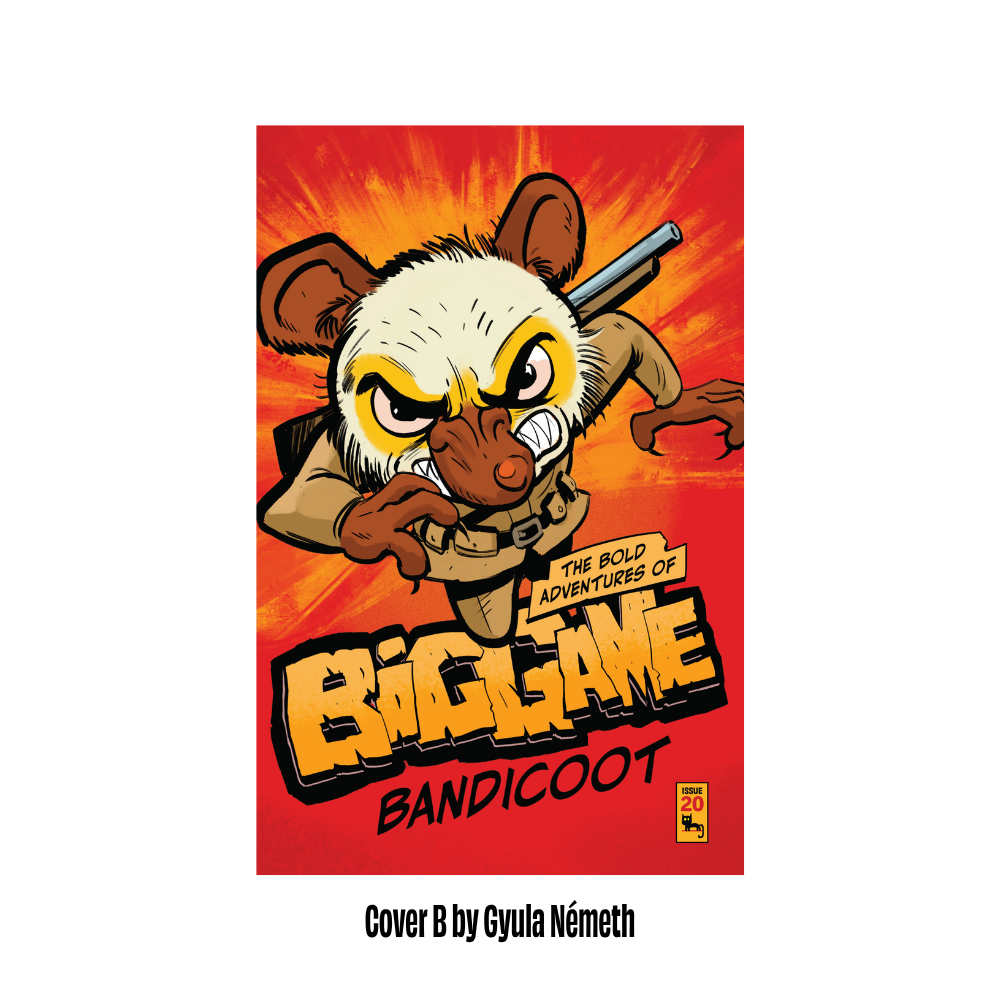
Cover B gives us The Bold Adventures of Big Game Bandicoot, but one name never appears anywhere on it: VeeFriends. The standard cover carries the VeeFriends masthead in the upper-left corner. This version keeps the Issue 20 badge and Big Game’s name while presenting the book like a standalone pulp-adventure comic.
10. The rugby-ball package sticker

In the official Issue 20 launch image, DirtDog read the black shape inside the little pink Issue 20 sticker as a rugby ball. The mark sits on the blind bag carrying Big Game’s rugby story.
11. The 14+ Warning Disappears With The Blind Bag

The back of Issue 20’s sealed Comic Collector Pack carries a blunt notice: “Heads up, parents! Ages 14+. Not intended for younger audiences.” Once the bag is removed, the comic doesn’t repeat that warning on its cover or interior pages.
That creates a problem for loose copies on the secondary market. A buyer or parent seeing only the comic has no visible notice that it was sold as 14+, even though the story includes murder, mounted heads, and stronger language.
12. The Battle Coin Put Moral Monkey Against Big Game Before The Comic Did

At about 19:27 in Is It Canon? Vol. 37, Anne pointed out that one of the five 2026 Battle Coins pairs Moral Monkey with Big Game Bandicoot. It was the only pairing whose characters had not already appeared together in a comic, so she believed the coin was teasing a connection between Issues 19 and 20.

Now we know what the coin was setting up. Moral Monkey enters Big Game’s trophy room disguised as Anthony, Big Game springs the laser trap, and the issue ends with him demanding Moral Monkey’s help collecting the VeeFriends.
Up Next
VeeFriends Comic Book #21: Articulate Armadillo is next in the numbered series.
Read about VeeFriends Comic Book #21: Articulate Armadillo.
Read all VeeFriends Comics Explained posts here: https://www.alieninks.com/pages/veefriends-explained?view=veefriends-explained-dynamic-v2
Reader signal
Comment on the decode
Share what you caught, what you disagree with, or what you want Ian to unpack next. Comments post to this article thread.
0 comments