
On X, @GhostKidArt tells you his lane immediately. His bio starts with "Disciple of Christ | Friendly Ghost" and says, "I answer all my DMs." But his collector identity is louder than his bio: he is THE Gritty Ghost Maxxi in the VeeFriends Community!
Now normally, being a Maxxi does not mean setting your collection on fire. To the contrary, it typically means you hoard as much of one character and their NFTs and merch as you possibly can. However, GhostKid is unique. He burns Gritty Ghost NFTs and physical Gritty Ghost merch, and he offers prizes and incentives for other people willing to join him. In one blunt post, he says, "Gritty ghosts get burned digitally and physically, it’s just something I do."
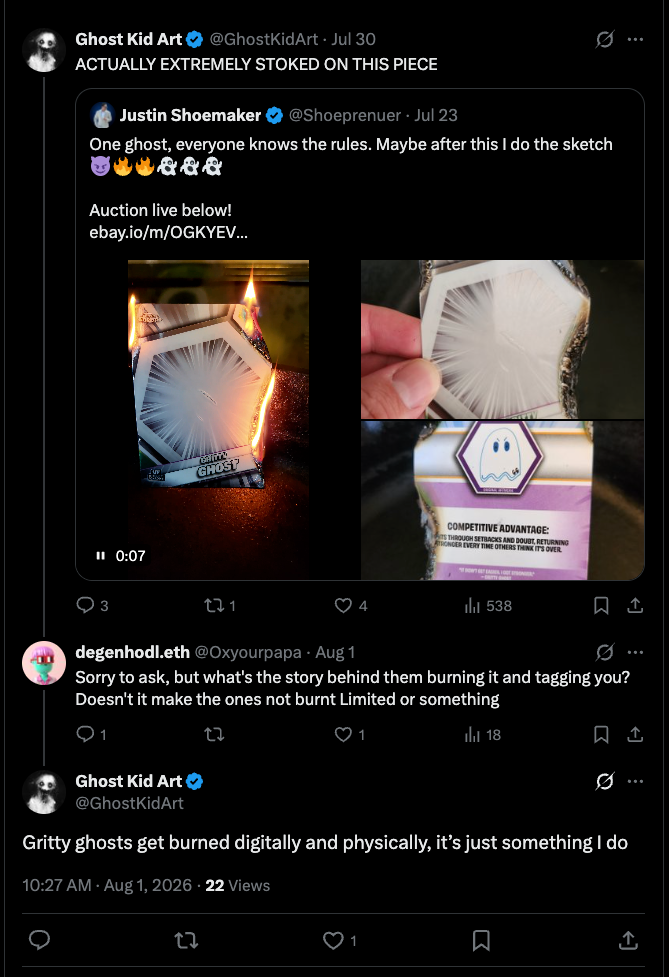
VeeFriends launched Gritty Ghost with 220 Series 2 NFTs, and OpenSea currently lists Gritty Ghost at 205. That puts Gritty fifteen below its starting supply. GhostKid's own burns and the collectors he inspired to join him have taken those fifteen Gritty Ghosts out of circulation. What a legend! No other community member has this type of influence over the fate of any of the other 250 VeeFriends Series 2 Characters.
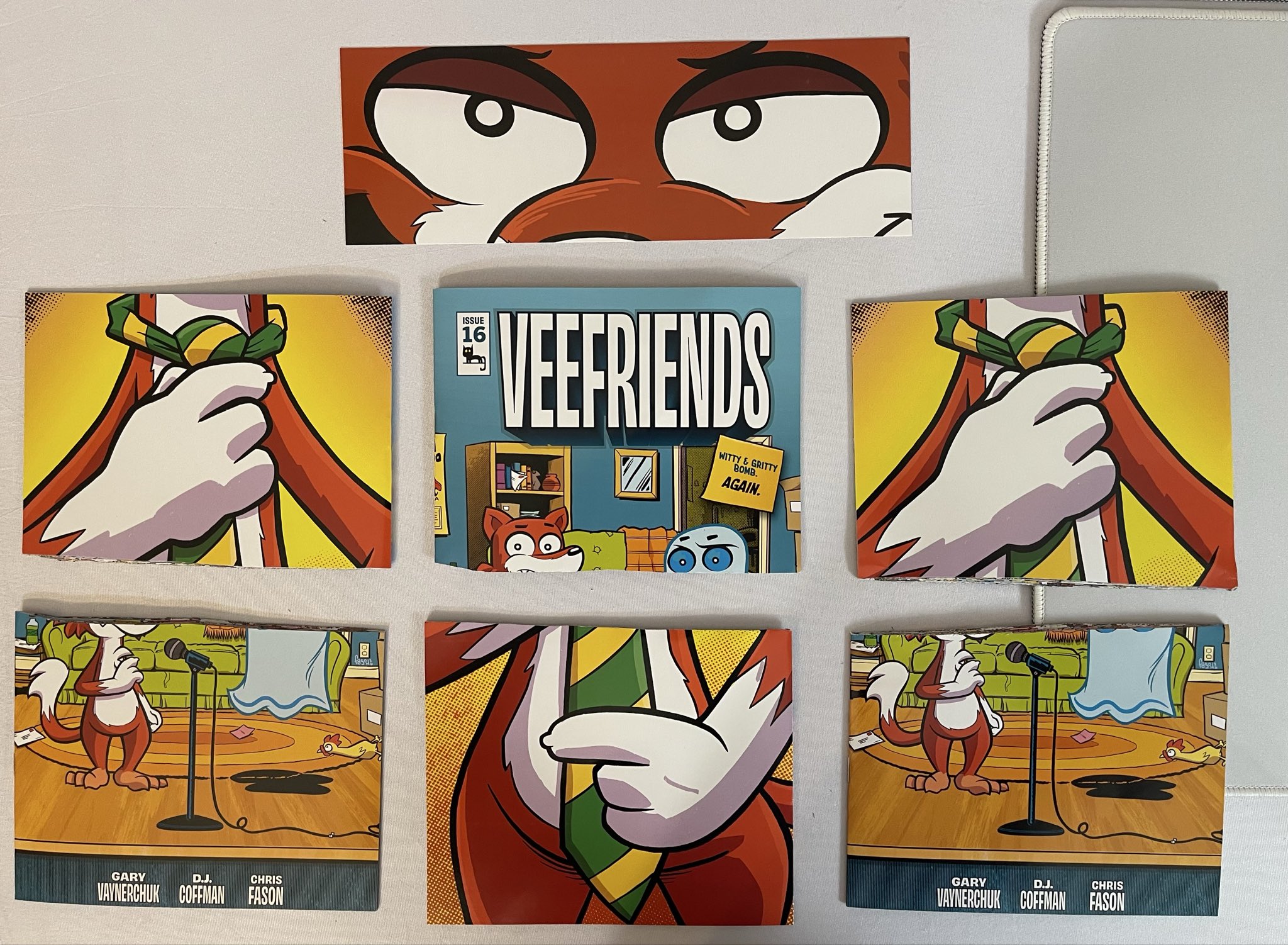
That influence was already on display around the Issue 16 drop. Before the later card burns, GhostKid offered a Series 2 NFT as the prize for cutting up three raw copies of the comic. On May 7, 2026, JakeBreaksLive took him up on it and cut three raw VeeFriends Comic #16 copies into pieces to unlock the NFT. Cutting up three raw comics is serious collector commitment but with serious prizes being rewarded, it makes a lot of sense.
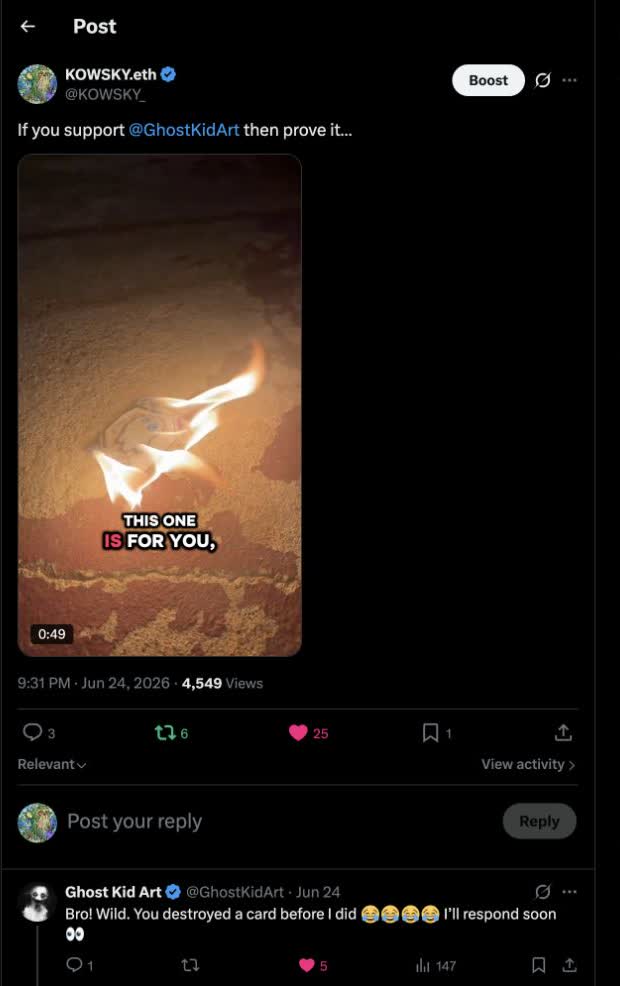
More than a month later, I ended up joining the GhostKid Gritty Ghost burn cult too. On June 24, I posted a video saying, "If you support @GhostKidArt then prove it..." while a Gritty Ghost card burned on screen. GhostKid replied that I destroyed a card before he did. Wow. I was honored to be the first to smolder a Topps Chrome 2026 Gritty Ghost card. Personally, I live for the whole let the world burn for the sake of art and passion attitude. So even though I haven't burned any NFTs yet, I do what I can and I am a hardcore supporter of GhostKid.
Speaking of me supporting GhostKid, I should mention that I am grateful he supports me as well. There is an Alien Traits by Alien Inks crossover here. Can you guess which of my 251 Alien Traits GhostKid owns?
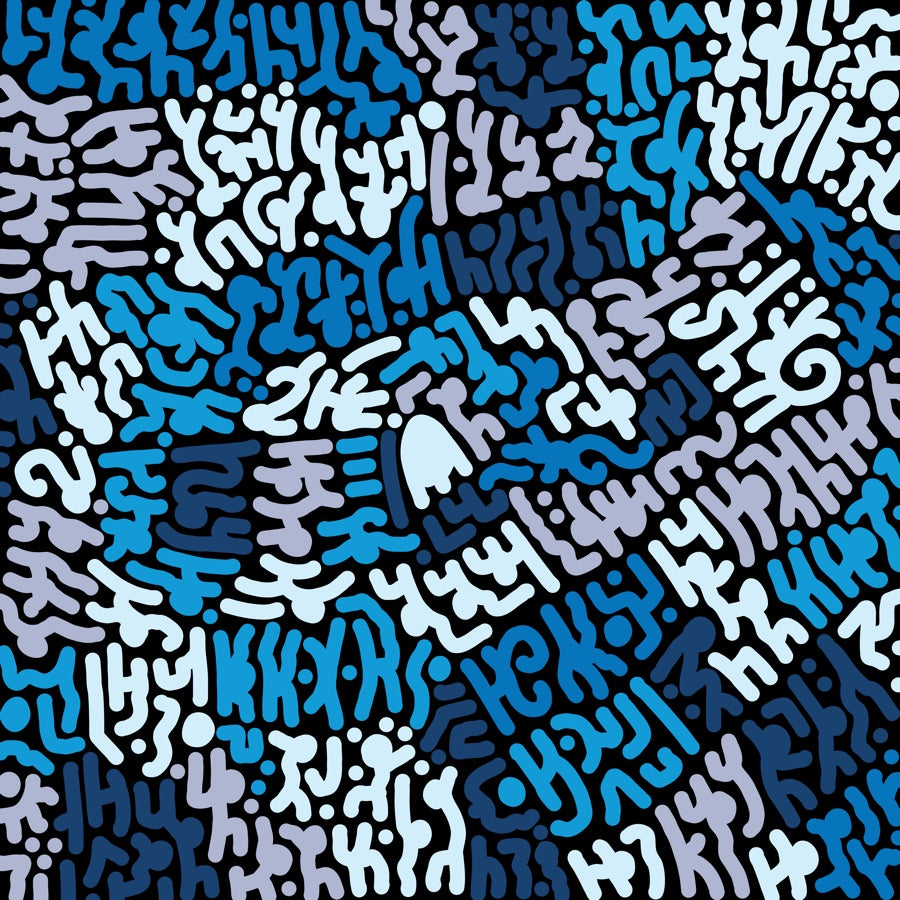
GhostKid is the holder of the Gritty Alien Trait from my official Alien Traits collection. Alien Traits is my 1-of-1 collection inspired by the 251 VeeFriends traits, with one Alien Trait for each of the 251 VeeFriends Series 2 traits. So the collector who burns Gritty Ghosts to make them scarcer also owns my one-of-one interpretation of the trait in the ghost's name. I am praying he does not burn it!
You can also open the Gritty page in the Alien Traits gallery. The inscription defines Gritty as showing up scraped, tired, and raw, then trying again before the wound is closed. But you can read the full, longer inscription on the page itself if you're interested.
Now, moving on to the analyses of VeeFriends Issue 16 itself, you may have noticed that there are 2 Main Characters, and that Gritty Ghost clearly only represents half of them. Or maybe less, given that he doesn't even have a body. Ba-dum-tch! Or maybe I should leave the comedy to Witty Weasel, who is the other main character featured in VeeFriends Issue 16. And in this issue, he is a struggling stand up comedian looking to make his big break in the comedy world while Gritty Ghost helps coach him to get there.
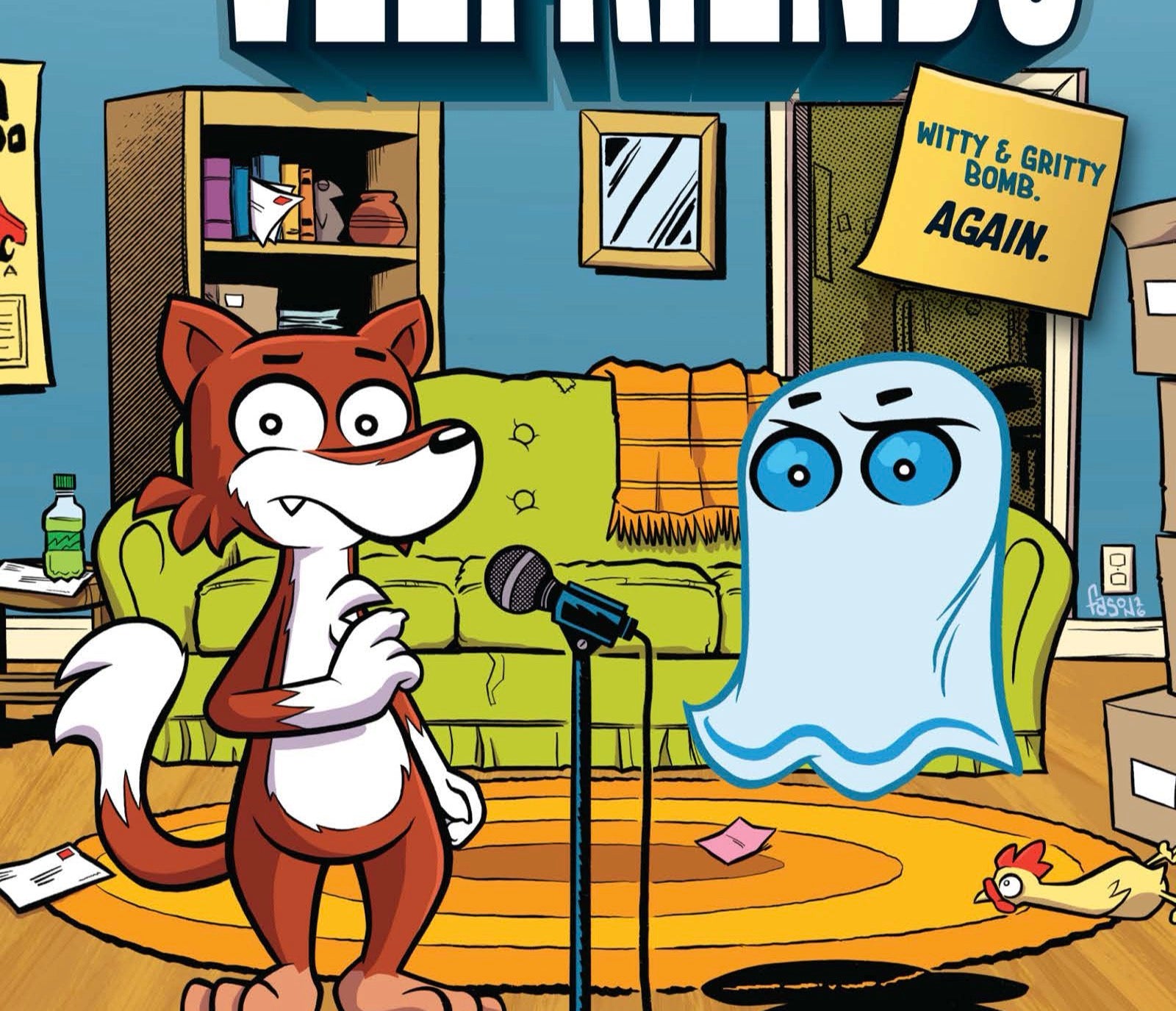
On this issue's cover, Witty Weasel is front and center with the microphone, while Gritty Ghost grins beside him from the apartment. Mail is scattered across the floor and shoved into the shelf, a rubber chicken sits in the apartment, and a partly cut-off poster hangs on the left. I do not know yet if any of those details are real clues, but the room already feels broke, chaotic, and handmade for a comedy issue about trying too hard.
The first page of VeeFriends Issue 16 opens with Witty Weasel on stage talking about getting fired. He asks if anyone can relate. Personally, yes. I have been fired. I can relate to how much that sucks, and how defeating it can feel when the decision is made for you and you still have to walk out into the rest of your day.
His angle is that getting fired in the morning is better than getting fired at the end of the day, because at least then you did not work the whole day first. I agree with the thought. It is a funny human frustration. But it is not such a funny joke, and the crowd reaction makes sense. Some characters look distracted. Some look bored. Some look like they are half-asleep. The panel reads like dead air more than open hostility. He is trying a joke about one of the worst parts of work, and the room is barely giving him anything.
The crowd reaction confirms that Witty is not only imagining the disconnect. His jokes are not landing. He has the setup, the rhythm, and the shape of comedy, but he has not found the real pulse of it yet.
When he ends the page with "tough crowd," the line has that classic stand-up feel. It makes me think of the old Rodney Dangerfield-style comedy language, where the comedian turns the room itself into part of the joke. But Witty is not just dealing with a tough crowd. His material is part of the problem too.

After the set, Witty orders something stronger than water. That starts the drinking joke, and the bartender plays along.
Then Witty jokes that legally he cannot drink. I immediately wonder what the legal problem is supposed to be. Is it because he is an animal? Is he underage? Is it both? The comic does not stop to explain it, but it is a weird enough line to notice. For me, the drinking joke starts to feel a little overdone, but that almost works inside the scene because Witty is not supposed to be crushing yet. He is trying to force the funny part out of every line, and the comic is letting us feel how forced that is.
Skip the bartender cuts through it. Witty says people tell him he is funny, but when he gets on stage, it does not translate. That disconnect is the real problem. Being funny in life is not the same thing as being funny on command, under lights, in front of strangers waiting for the joke to work.
Skip tells him he is trying too hard. Comedy is not in the head. It is in the heart. If Witty does not feel it, nobody else will.
That feels true to me. The funniest moments in my own life are usually not moments where I am consciously crafting something. They just come out in the moment. I am not a comedian, but people have told me before that I should try comedy because I can make people laugh. The difference is that I am not usually trying to win a room. I am just reacting honestly and something hits. Writing a script you can enthusiastically repeat every single night, and have it consistently land, is a much harder task.
That is where Witty is stuck. He is unsuccessfully attempting to think his way toward funny instead of letting something real move through him.

Witty explains that he has been doing this for more than a year. Same open mics. Same grind. Same hope that something will finally break open. But after more than a year, he feels like he is spinning his wheels.
Once the bartender hands Witty the glass, we can see that whatever he ordered is not water. Maybe it is whiskey. Maybe it is apple juice. I do not know. But now the question is sitting right there on the page: what is this main cartoon character actually drinking in a comic that does not seem to carry the same age warning that VeeFriends Issue 05 did?
I am not saying that makes the issue wrong or illegal. But it is a real parent-reader pause point. Some parents would not care at all. Some would absolutely notice that a kid-marketed comic is playing with drinking language inside a bar scene. I noticed it too.
Witty brings up the Big Show in New York City. That could mean nothing, or it could mean almost anything. My first read is Saturday Night Live because of the comedy dream, the New York setting, and the sketch-show lane. It could also be a broader comedy-world idea, so I am not locking it in as confirmed. I am saying the phrase makes my brain go there.
This is where the issue hits one of the hardest real-life questions in the whole story. When you are chasing a dream, how do you know whether the answer is to push harder, or to accept the feedback that it is not working out and maybe this is not what is meant for you?
There is no clean motivational-poster answer. Sometimes people quit too early, and the only difference between them and the person who makes it is that the successful person kept going after almost everyone else would have quit. But perseverance still does not guarantee that ending. Sometimes people keep going too long, and giving up on the wrong dream is what finally lets them find their true self.
That uncertainty is exactly why patience and perseverance can create such asymmetric upside. Most people will not keep showing up through years of effort, no results, bills, embarrassment, and no guarantee that any of it will work. If you are chasing the right dream, outlasting that stretch can separate you from almost everyone else. The problem is that perseverance cannot tell you whether the dream is right. You still have to be honest enough to ask whether you are fighting through the hard part or refusing to accept the feedback that it is not working and another path may fit you better.
Witty makes up his mind and says he is going to die trying. That is a very funny place for a VeeFriends comic to land because it immediately makes me think of 50 Cent. Get Rich or Die Tryin' was 50 Cent's debut studio album, and Witty has basically reached the open-mic weasel version of that philosophy.

The next scene proves that saying you are going to die trying and actually living through the consequences are not the same thing.
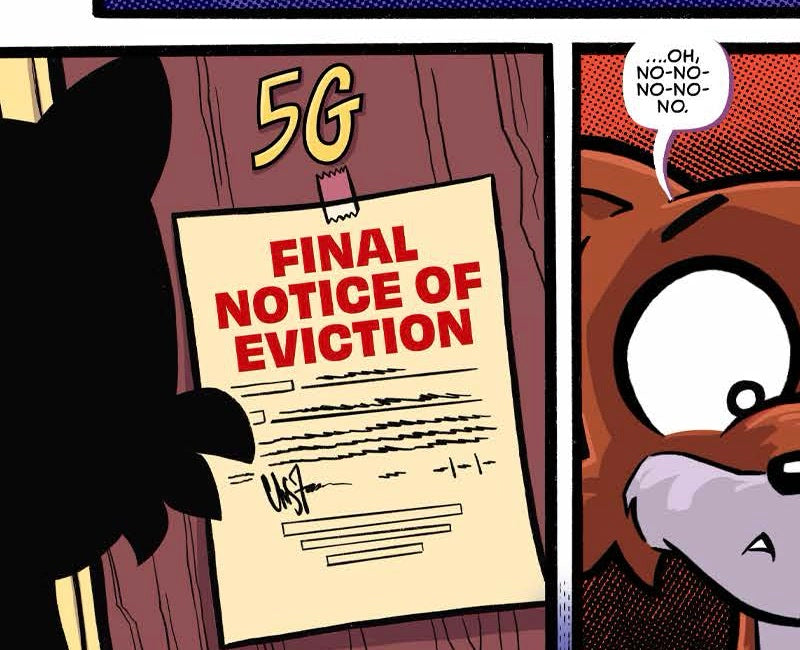
Witty is still doubting himself on the way home. Maybe he is not cut out for comedy. Maybe he needs to do something different. Then he gets to his apartment and finds an eviction notice on the door. That sucks for anyone, but it is especially brutal after the same day already gave him a fired job and a bombed set.
The apartment number is 5G, which immediately gets my attention because 5 is GaryVee's favorite number. The G could be Gary. It could be nothing. It could be a tiny phone-network joke because we all have 5G on our phones now. I am not building a major theory out of it, but this is VeeFriends, so a visible 5 is rarely invisible to me.
Witty says they are getting evicted again, which tells us this is not the first financial disaster in this apartment. Then he starts asking if Gritty spent the rent money again.
That is the accountability problem. If Gritty spent the rent money wrong before, why was he trusted with the rent money again? Good intentions do not automatically make a bad decision less bad. Rent is rent.
There is also a Big Big Show poster in the apartment, which loops back to the Big Show dream Witty mentioned earlier. I still read that as sitting somewhere in the SNL / big comedy-break / New York dream zone, but the comic has not confirmed the exact reference yet.

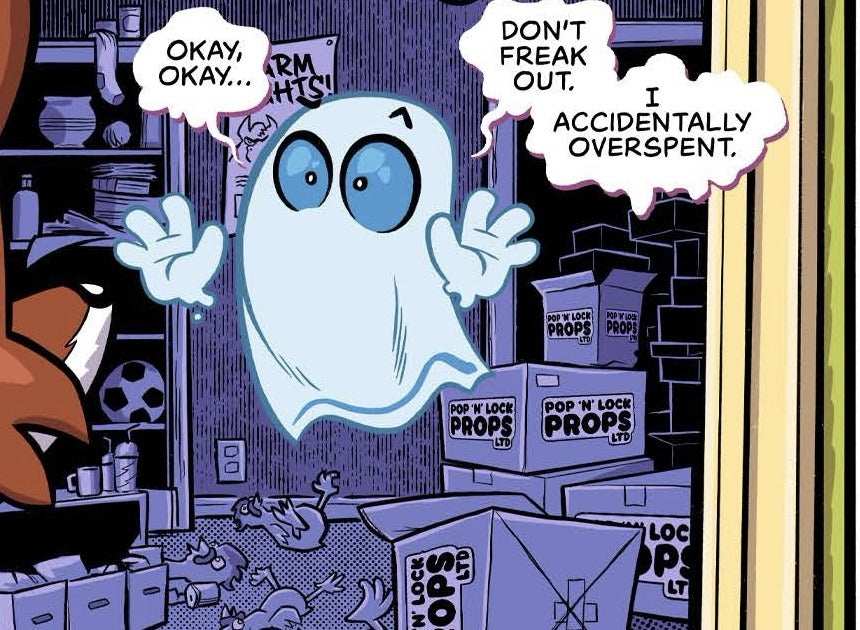
Gritty reveals what happened: he spent the rent money on props. But they are not prop comedians. Womp womp.
Witty explains the timing is especially terrible because he also got fired that morning. Where did Witty work? What did he get fired for? The issue does not tell us yet, but the missing job detail keeps the collapse from feeling abstract. His life is coming apart from multiple directions at once.
Now Witty is not only worried about losing a job or being broke. He is worried about losing his home and starving to death. Failure gets physical fast when rent and food enter the story.
Gritty repeats Skip's point that Witty is trying too hard to be funny, and Witty admits Skip said the same thing. Gritty also says he does not trust Skip, which may be nothing, but I am putting a pin in it. If Skip comes back later, that line may read like foreshadowing.
By the end of the scene, Witty is already wondering if he should quit again. That directly undercuts his earlier "die trying" declaration. And honestly, that is real. Conviction can sound clean when you say it at the bar. Then the eviction notice hits, the money is gone, and suddenly the dream starts asking for more than a speech.
Gritty will not let him quit, but that does not erase the accountability issue. He blew the rent money. He may be trying to help, but help that makes the practical situation worse still has to answer for the damage.

Then the comic makes Gritty Ghost much more interesting.
Witty says maybe he is losing his mind because he is talking to a ghost. That is a strange comment because before this, I was not questioning Gritty's existence. This is VeeFriends. There are animals, monsters, ghosts, robots, dragons, and whatever else walking around like part of the world. I was simply accepting Gritty as a ghost character.
But Witty's line changes the read. The official VeeFriends write-up calls Gritty Witty's invisible roommate, so the fact that other people do not see him is intentional. That answers one question and creates several more. Is Gritty only visible to Witty? If so, why? And if other people cannot see him, how did he buy all those props and spend the rent money?
The physical logic gets even stranger when Witty shoves his hand through Gritty. So Gritty can apparently interact with money, rent, props, and physical objects, but Witty's hand passes straight through him. Maybe Gritty can choose when to be solid. Maybe physical objects work differently from living bodies. Maybe the issue is choosing cartoon logic over spelling out a full ghost-physics rulebook. I do not know.
This also sends me back to the cover, where Gritty appears to cast a shadow. That makes him feel real enough to block light, but not real enough to block Witty's hand. That is not a complaint. It is a question the issue makes hard to ignore once Witty himself starts asking if talking to Gritty means he is crazy.
Witty then crosses a line by saying Gritty was not even good at comedy when he was alive. I know Gritty Ghost is obviously a ghost, but hearing the comic reference his death directly makes me immediately wonder who he was before he died. What did he look like? Have we already seen him somewhere else in VeeFriends before he became Gritty Ghost and just did not know it?
I would like to think I would have caught that, but ya never know.
Gritty points out that calling him a dead failure while punching through him is a low blow. Fair. But he also reminds Witty that at least he actually died trying, which is more than Witty can say in this moment.
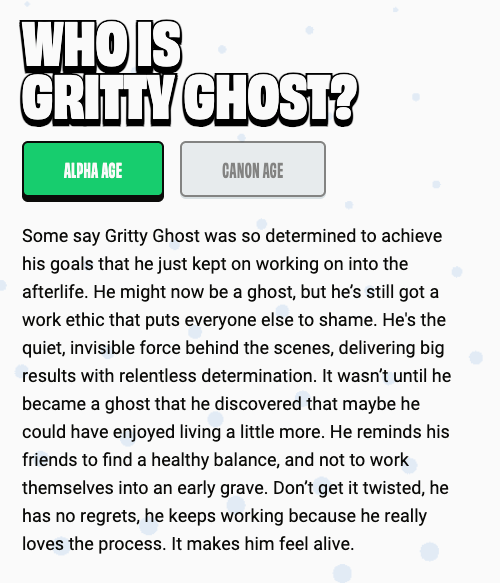
The official Gritty Ghost bio makes that darker than a one-line joke, with an important caveat: the screenshot is from Alpha Age, not Canon Age. That means it may work its way into canon, but I am not treating every detail as definitely confirmed in-story yet. Still, the Alpha Age bio says Gritty worked straight into the afterlife and only then realized he might have enjoyed living more. He still loves the process, but now he warns his friends not to work themselves into an early grave. That makes his role with Witty more complicated. Gritty is pushing him not to quit while also trying to keep Witty from repeating the parts of his own drive that became destructive.
That is the harder part of the scene. Gritty apologizes for spending the rent money and says he was only trying to pull Witty out of a rut. I believe him. I also think it is still totally messed up. The road to hell is paved with good intentions for a reason. Wanting a good result does not make you unaccountable for the bad consequences of how you tried to get there.
Then Gritty reveals that he did figure out some of the secret formula for comedy, but too little of it too late. Witty asks what happened to him and how he died. Gritty does not answer. He shifts the focus back to Witty being alive.
That is one of the most captivating details in the issue for me so far. We are told Gritty died trying. We are not told how. If these characters continue, I expect that question to come back.

Gritty gives Witty the formula: tragedy plus time equals comedy.
That line is not invented by the comic. Tom brought up the quotation history on Is It Canon?, and Quote Investigator traces versions of that comedy equation through names like Steve Allen and Carol Burnett, with Burnett also attributing a version to her mother. The exact origin is messy, but the idea is famous for a reason.
Gritty's version is that Witty is feeling sorry for himself and telling jokes he thinks people want to hear. The change is that he needs to speak from the place that actually hurts. He needs to turn the pain into laughter.
The instructions are not perfectly clear if you treat them like a writing class. But Witty seems to understand the objective. Stop performing a fake version of funny. Tell the truth from the part that still hurts.
Gritty also jokes that stand-up is called that because comedians need to stand up to their past and their trauma. Obviously, it is called stand-up because the comedian stands up in front of a live audience. But I like Gritty's version too. For this issue, it works.
Open Mikes is still open until 2 AM, and Witty is unemployed now, so Gritty gives him the only advice that fits: get back in the action and try again.

Witty returns to Open Mikes and goes right at the formula Gritty gave him. He says tragedy plus time equals comedy is the recipe, and he is going to cook something up for the crowd.
That gets a laugh.
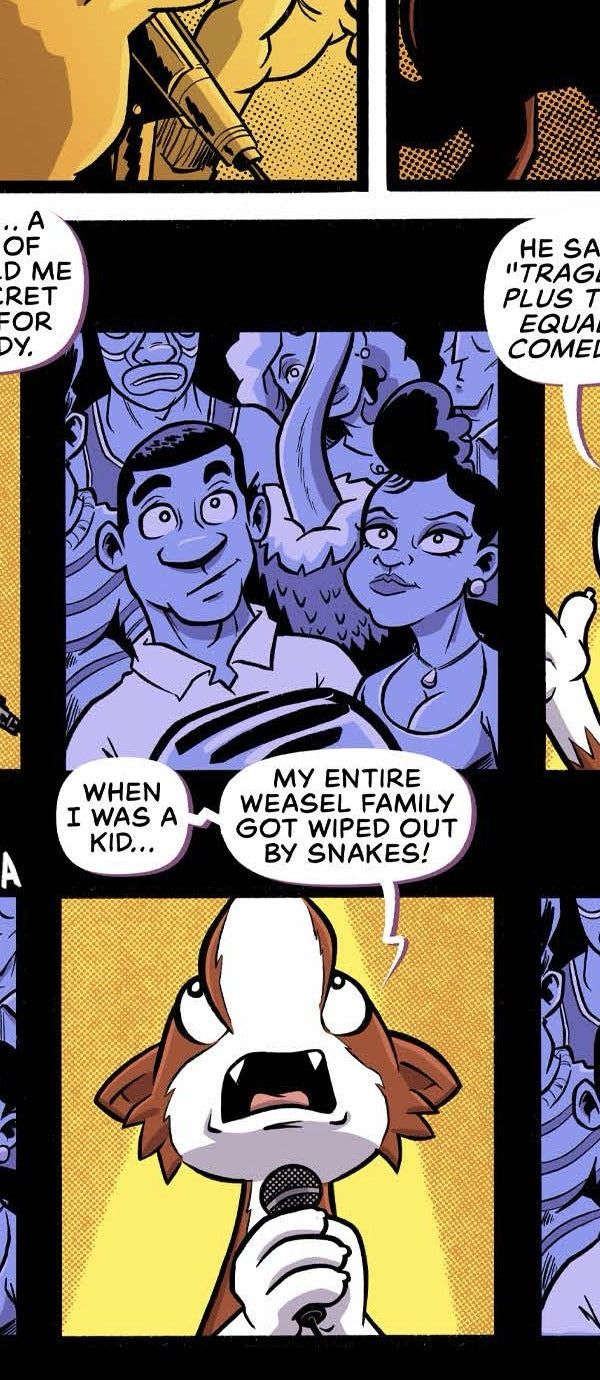
Then he goes deeper into the tragedy and tells the room that his entire family got wiped out by snakes when he was a kid. In the background, I can see a character in what looks like a wrestling mask, plus what appears to be Organized Ostrich in the audience. The masked character especially feels like a Farm Fights nod.

Witty explains he was the only one who got away when snakes ate the rest of his family. Huge tragedy. But it was ages ago, so now it is hilarious, he guesses?
I understand what the comic is doing, but this part feels clunky on purpose or clunky in execution. Tragedy plus time is a real comedy formula, but Witty is applying it so literally that the first version is not really a joke. "My entire family was murdered, but hey, it was ages ago, so I guess it is hilarious" does not have enough surprise in it. There is no real punchline yet.
Comedy is not only tragedy plus time. A lot of humor also comes from incongruity, from the brain expecting one thing and then getting turned a different way. That instinct has research behind it. Incongruity-resolution models describe a setup creating an expectation, a punchline breaking it, and the audience resolving the turn from a new perspective. The surprise still has to make enough sense for the brain to catch up and laugh.
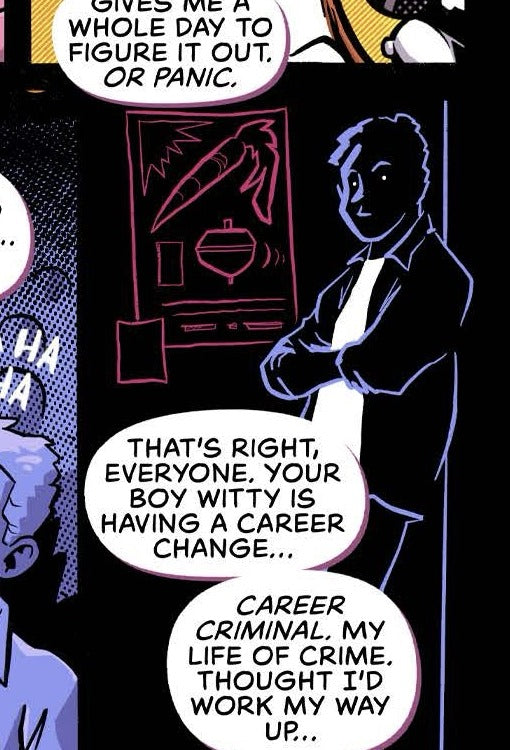
That is why the fired-in-the-morning joke works better when Witty brings it back. He says the bright side of getting fired early is that it gives him the whole day to figure it out, or panic. That is closer to an actual joke because the second option is the wrong option. You do not plan to spend the day panicking. The sentence turns where your brain did not expect it to turn.
Then he gets to the best punchline in the sequence: unemployment for breakfast and a gas station snack heist for dinner. That is an actual joke. Unemployment is not food, and losing your job does not usually lead straight into a tiny life of crime. The brain has to make the jump, and that is where the laugh lives.
The crowd laughs hardest there, and that tracks. The issue shows Witty finding the difference between saying painful facts and turning painful facts into a joke.
Tom caught another part of that change on Is It Canon?: Witty's delivery is different too. The first time he tries the firing material, the ellipses break it into hesitant pieces: "I guess I'm glad it happened early in the day? Unemployment... for breakfast." This time the joke moves without those pauses. Witty did not only find better material. He found a better way to say it.
At the edge of the page, a shadowy figure watches him. The panel isolates him from the crowd and makes it clear that somebody specific is listening from the side.

Witty's set slays. The crowd is laughing, and the manager walks over to him and Gritty.
Then the manager steps directly through Gritty.
That brings the ghost-visibility question right back. It seems like only Witty can see and interact with Gritty, but the comic still has not explained the practical rules. Can anyone hear him? Can anyone see him under certain conditions? Can he move objects even if people do not perceive him? Did Witty meet Gritty after his family died? Is Gritty somehow connected to Witty's dead family?
I am not saying the answer is yes. I am saying the issue keeps giving us enough weirdness that I cannot ignore the question.
Witty and Gritty reflect on how Witty let his pain out, and the tragedy plus time formula lands as more than a quote. It becomes the shift in how Witty performs. He stops guessing what a comedy crowd wants from him and starts telling the truth in a way the crowd can actually feel.
Then the shadowy figure from the side of the stage appears at the door and asks to speak with Witty. Gritty is shocked, which tells us this is not just a random manager or fan.

We find out the man is Tokyo Joe, and Witty and Gritty clearly know who he is.
This name sent me to Google. Tokyo Joe is also a 1949 Humphrey Bogart film noir about an American veteran returning to post-war Tokyo and getting pulled into crime and underworld trouble around his old nightclub. Is this comic character supposed to connect to that movie? Is Tokyo Joe a performer name inside the VeeFriends comedy world? Is he an actor, a character, or a coincidence?
I do not know yet, so I am not treating the movie connection as confirmed. But when Witty and Gritty start to say they have watched every... what? Every movie? Every special? Every performance? The comic is clearly asking us to understand Tokyo Joe as a known figure in their world, even if the reader is catching up in real time.
Joe tells Witty that what happened on stage was not just a bit. It was Witty's heart healing. That lines up with Gritty's philosophy. Witty confirms he was just honest and spoke from the heart.
Then Joe says Witty reminds him of himself when he was starting out: raw, scared, and full of something he cannot fake. That is the opportunity Witty has been trying to find all issue. Not because the universe randomly rewarded him, but because he finally put something real on stage.
Joe invites him to perform at Tokyo Joe's Comedy the following night. He also gives Witty money so he and Gritty can get dinner, joking that Witty does not have to shoplift dinner or turn to a life of crime. The comic is letting the earlier gas station snack heist punchline echo back into the plot.
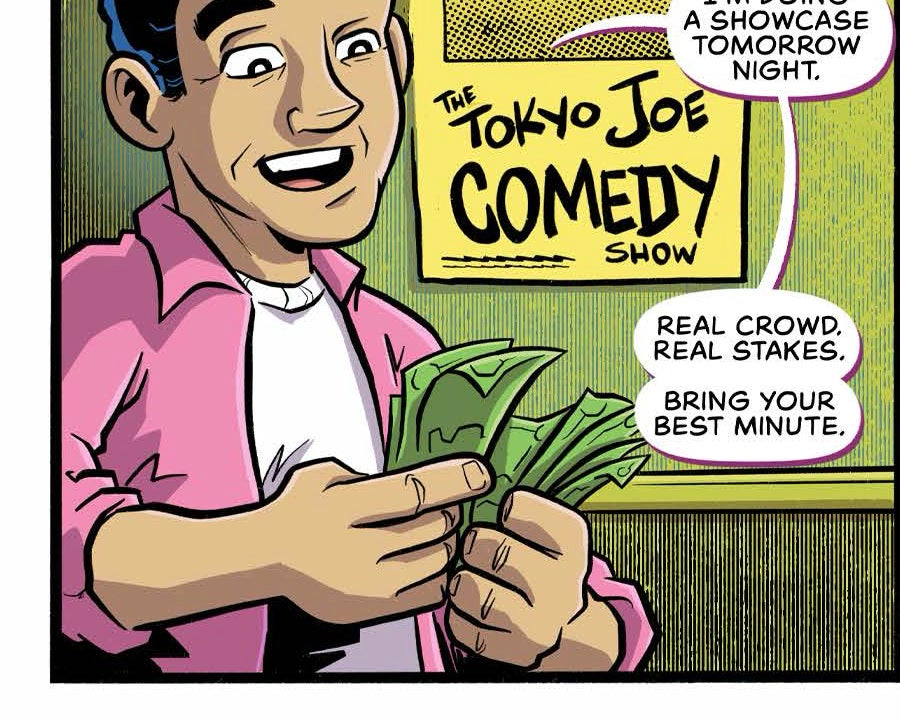
On Is It Canon?, Tom connected Tokyo Joe asking for Witty's "best minute" to Kill Tony, where comedians drawn from a bucket perform one-minute sets. A comedian asking for somebody's best five or ten minutes would not catch my attention the same way, but one minute is unusually specific. Tom also remembered seeing D.J. Coffman say he was a fan of the show. That does not confirm the reference, but the format and the wording line up well enough that I think Tom may be onto something.

Witty and Gritty go back home with dinner, and the food spread is absurd in the best way. Pizza, Chinese food, sushi, and a bunch of containers on the table. It makes sense that Witty would pig out once somebody else paid for dinner, but how did he mix that many cuisines at once? Did he order from three different restaurants? Did he do some kind of combined Uber Eats order? I do not even know if VeeFriends World has Uber Eats. Actually, only Witty is eating because Gritty is still a ghost, and Gritty has to sit there complaining about how hard it is to watch.
That detail is funny, but it also keeps poking the ghost mechanics again. Gritty can spend rent money. Gritty can buy props. Gritty can follow Witty around and coach him. But he cannot eat dinner. He can affect Witty's life, but he still cannot share something as basic as dinner.

Once dinner is over, Witty keeps thinking about Tokyo Joe. He did not talk down to him or laugh at him. He actually saw him. After getting fired, bombing onstage, and finding an eviction notice on his door, Witty finally has someone he respects treating him like a real comedian.
Gritty answers with a perfect double meaning: “That’s what happens when you keep standing up!” Witty kept doing stand-up, but he also kept standing back up every time his life gave him another reason to quit.
Gritty lets him enjoy that realization for about three seconds before declaring the moment over. Now they train. Already? Apparently being seen by your hero earns you one emotional moment before Gritty puts you straight back to work.
Witty understands that training cannot mean returning to the same forced jokes and overthinking that made him bomb. But he does not throw preparation away completely either. He wants to study what worked and understand why it worked.
Speaking from the heart does not mean refusing to learn from the result. Witty finally has a successful set to examine, and he pulls out a book labeled “Witty’s Joke Journal” to do exactly that. For the first time in a long time, the dream feels real because he finally has something real to build from.

Witty and Gritty open the Joke Journal and compare the set that bombed with the set that finally worked.
They start with the fired joke. Gritty notices that Witty dropped the whole part about getting called into the office when he performed it again. Witty did not even realize he left it out. If part of the joke can disappear without Witty noticing or the joke losing anything, it probably was not necessary. It was filler.
Honestly, that is a pretty useful writing rule beyond comedy too. Sometimes you do not realize which parts are weighing something down until you remove them and nothing is missing.
Then they break apart the successful set. Tragedy plus time equals comedy. Family killed by snakes. Trauma. Unemployment for breakfast. A gas station snack heist for dinner. Witty stopped forcing a joke out of every sentence and started connecting the painful parts of his life in ways the crowd did not expect.
Gritty says that path through the material felt right, and Witty already has an idea for the final line. He refuses to tell Gritty what it is because he wants it to be a surprise. Apparently Gritty has to wait for the show like everybody else.
Witty is still studying, writing, and changing the act. The difference is that he is responding to what actually happened instead of repeating the same approach and hoping harder. He is cutting the filler, keeping what landed, and building something new from it.

The next night, Witty and Gritty arrive at Tokyo Joe’s Comedy, and the line is already stretching down the block. This is a much bigger opportunity than another open mic with five half-interested people in the room.
The narration says there are moments that change the trajectory of your life, when all the hard work, trials, and tribulations finally feel like they are about to pay off. It usually does not happen the way you imagined, but it can happen the way you needed it to.
However, it will not happen on its own. You cannot sit idly by. You have to stand up and be seen. That gives us the same double meaning Gritty used earlier. Witty has to keep standing back up, but he also has to literally perform stand-up in front of people who can see what he is capable of.
The comic finally gives us a more specific answer to the earlier question about pushing harder or accepting that something is not working. Witty kept going, but he did not keep doing the same thing. Those are not the same. He listened to Skip and Gritty, stopped forcing the material, told the truth, studied what landed, cut the filler, and came back prepared.
Now Witty tightens his tie outside the biggest room he has played so far. Tonight is his moment, but the opportunity only exists because he kept showing up and was willing to change what he did once he got there.

Backstage, every comedian draws a number from a bucket to determine the performance order. Gritty immediately tells Witty to pick a good one, as if a random number is going to respond to motivational coaching.
Gritty is also floating around a packed room full of comedians, pointing at the bucket and talking directly to Witty, while nobody else acknowledges him. Once again, the comic makes it look like Witty is the only person who can see or hear him.
The host explains that each comedian performs when their number is called. A yellow light means wrap it up. A red light means get off the stage immediately or a trap door will open and launch you into the basement. Witty completely believes him. The host has to explain that it was a joke and tell Witty to lighten up. Not being able to recognize somebody else’s joke is probably not the most encouraging sign right before your biggest comedy set.
Then Skip appears holding number four. He is not only the bartender who happened to give Witty good advice. He is a comedian making a comeback, and he says he is opening for Witty. Now his ability to diagnose Witty’s problem at the bar makes a lot more sense.
Skip still leaves a little mystery behind. When Witty asks if he is making a comeback, Skip answers, “Something like that, pal.” Maybe that is just how Skip talks. Maybe Gritty’s earlier distrust of him was pointing toward something. I still have my eye on him.
Witty draws number five. Of course he does. We already have apartment 5G, and five is GaryVee’s favorite number. Now the biggest performance opportunity of Witty’s life puts him in the number-five slot. Coincidence or not, the fives are starting to pile up.

Skip takes the stage and immediately starts performing Witty’s material. “I got fired this morning.” Getting fired early in the day. Unemployment for breakfast. These are not two comedians accidentally finding the same general premise. Skip is using the exact jokes Witty developed at the bar the night before.
Gritty loses it. He says he knew he did not trust Skip and tells Witty to confront him. That earlier distrust line was not random after all. Gritty now believes Skip runs the open mic at his bar so he can steal jokes from struggling comedians and pass them off as his own.
The timing makes the theft even worse. Skip drew number four, and Witty drew number five. If Witty walks out and performs the set he prepared, the entire crowd could think Witty stole the material from Skip.
Witty looks completely defeated. He asks what good confronting Skip would do and says the whole situation feels like one big joke, except the joke is on him. Yesterday he finally found his voice. Tonight somebody else used it first.
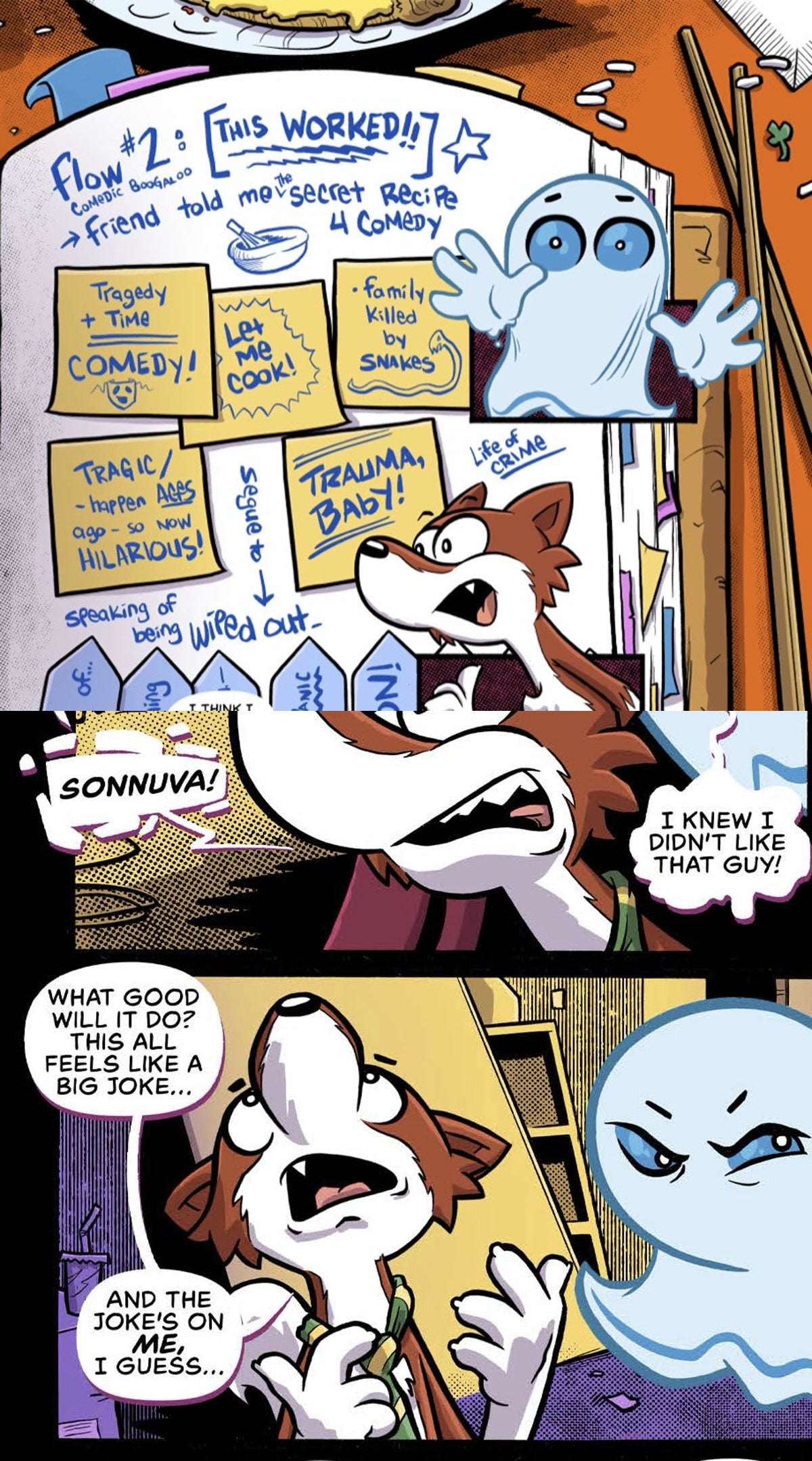
Tom connected those two lines to It's Always Sunny in Philadelphia on Is It Canon? The first clue is "Comedic Boogaloo" in Witty's Joke Journal, which sounds like the episode title Chardee MacDennis 2: Electric Boogaloo. "Electric Boogaloo" was already a sequel joke long before It's Always Sunny, so that line by itself would not convince me.
The second clue is much harder to shake. In The Gang Broke Dee, Dee's stand-up finally starts landing when she turns the pain and insults aimed at her into material and repeats, "the joke's on me." Now Witty is another struggling comedian whose breakthrough comes from turning real pain into comedy, and he reaches almost the same line when Skip steals his material. Put both clues in the same issue and Tom's theory gets a lot stronger. I am still not calling it confirmed. It could be intentional or a perfect coincidence, but I cannot unsee the parallel now.
Skip walks backstage to applause from the other comedians and tells Witty that he warmed the crowd up for him. Then he says, “Break a leg,” and laughs. After the stolen jokes and his weird “Something like that, pal” answer, that does not feel like an innocent good-luck wish.
Before Witty has time to rewrite the set, confront Skip, or even fully process what happened, Tokyo Joe calls number five. Witty is up.

Witty walks onto the stage with no usable set and immediately starts stumbling. “My friend... uhm... my friend, he...” The crowd gives him a small chuckle, but he is clearly trying to figure out what to say while he is already saying it.
He does not repeat the stolen material, and he does not march backstage to confront Skip. He starts talking about what is happening to him right now.
Witty tells the crowd that his friend gave him the secret recipe for comedy. Someone calls out, “What’s the secret, #5?” There is that five again. Witty says he would love to share it, but there may be a joke thief among them. Gritty immediately starts cheering him on.
Earlier, I talked about how difficult it is to write a script you can enthusiastically repeat every night. Witty now has the opposite problem. His script is gone, so he has to trust the natural reaction that comes out of him in the moment.
He tells the crowd that he performed at a dive bar down the street the night before, and the bartender stole his jokes and passed them off as his own. The crowd starts reacting to the accusation, and Witty keeps building on it. He says he brought jokes for tonight, but apparently they were stolen. Has anyone seen any jokes laying around?
Skip’s face drops. Witty still has not said his name, but Skip knows exactly who this set is about.
Then Witty asks the most important legal question in comedy: Is there a jail for joke thieves?

The crowd starts laughing, and Witty tells them he wishes the story were a joke. It is not. He talks about loving comedy, devoting his life to the craft, and finally reaching a stage he has dreamed about, only to discover that someone he considered a friend stole his material. It feels like a punch in the gut.
Now the audience wants a name. Gritty wants one too. He is practically trying to start a mob from the side of the stage.
Witty still refuses to fully throw Skip under the bus. He says he is not a rat and that people make mistakes. When the crowd starts yelling that joke thieves suck, Witty slows them down and says joke thieves are innocent until proven guilty in a joke court of law.
That is an actual joke, and the room laughs. Witty has gone from reporting what happened to controlling the story again.
Then he gives them the closest thing to a name: “Don’t do open mics at dive bars called ‘Skip’s.’” The crowd immediately understands and asks if Skip is stealing jokes.
Skip stole Witty’s prepared jokes, but he could not steal where those jokes came from. The words were repeatable. Witty’s perspective was not. Skip could copy the fired joke and the unemployment-for-breakfast line, but he could not copy Witty’s ability to react to a brand-new disaster and turn it into something funny while it was still happening.
That proves Witty did not simply stumble into one successful set the night before. At the bar, he had Gritty coaching him and time to understand what worked. Here, he has no script, no warning, and no time to recover. He gets hurt seconds before walking onstage and still finds the joke inside it.
It also stretches the tragedy-plus-time formula. Almost no time has passed. Maybe “time” does not always mean waiting years before something becomes funny. Sometimes it means finding enough emotional distance to see what is happening to you as a story, even while you are still living through it.
Witty does not use that realization only to destroy Skip either. He refuses to start a mob, does not directly name him, and turns the accusation into the “joke court of law” and Skip’s bar punchlines. He tells the truth, protects his own integrity, and still makes the room laugh.
Skip stealing the set forces Witty to prove that he has finally become more than the set. He can lose every prepared line and still be funny because the comedy is coming from him now.

After the set, Gritty tells Witty he was too kind. He thinks Witty should have burned Skip to the ground. After opening this article with GhostKid’s obsession with burning Gritty Ghosts, it is pretty funny to hear Gritty Ghost demanding that somebody else get burned for once.
Witty answers that you can never be too kind. Gritty still has to admit the set was pretty funny.
That exchange shows the difference between kindness and weakness. Witty did not stay silent or let Skip take credit for his work. He exposed exactly what happened in front of the entire room. He just did it without directly ordering the crowd to destroy him.
Tokyo Joe stops Witty as he tries to leave. Witty immediately apologizes for accusing Skip, but he cannot fully take it back because Skip really did steal the jokes. Witty says he would rather keep his integrity than participate in a game of thieves.
Witty believes that decision may have cost him the biggest opportunity of his life. He chose to tell the truth before knowing whether Tokyo Joe would respect it, punish him for it, or never invite him back. That is what gives the integrity line weight. It was not a safe speech made after Witty knew everything worked out.
Then Tokyo Joe tells him he did the right thing. Witty is genuinely surprised. Even Gritty has to confirm it for him.
Witty’s kindness did not require pretending Skip was innocent. His integrity did not require surrendering the stage. He found a way to hold Skip accountable, protect himself, and make the crowd laugh without becoming as dishonest as Skip or as destructive as Gritty wanted him to be.

Tokyo Joe tells Witty that the world is full of people like Skip, especially in comedy. The easy response would have been to light Skip on fire and throw him to an angry mob. Gritty immediately agrees with that plan because of course he does.
Joe says Witty chose the harder path. He took a terrible and hurtful situation and made it funny. He delivered the accusation clearly enough to mortify Skip, but subtly enough that the set never stopped being comedy. The crowd got the message and laughed in the process.
That is what makes Joe call Witty a real comedian. He is not only praising the jokes. He is praising Witty’s judgment. Witty knew how far to push, when to pull back, and how to make Skip face what he did without losing control of the room.
Maybe Skip learned something. Maybe he did not. Either way, Joe says Witty will be living rent-free in his head. Given that Witty was facing literal eviction one day earlier, living rent-free anywhere is at least a small financial improvement.
Then Tokyo Joe offers Witty something much bigger than another performance. He wants Witty to open for him across ten tour stops, ending at the Big Big Show in New York City. The dream Witty could barely keep believing in is suddenly becoming an actual route with dates, cities, and a headliner willing to bring him along.
Witty immediately turns to Gritty and asks if he is up for it. Gritty says, “Of course we are!” Joe responds by asking who “we” is, so Witty awkwardly corrects himself and says he meant only himself.
Then Joe drops one of the biggest reveals in the issue: “It’s okay, Witty. I can see the ghost, too.”
Okay. There it is. Witty is not the only person who can see Gritty.
At first, that appears to answer the ghost-visibility question. When Tokyo Joe gave Witty money so he and Gritty could get dinner, he was not politely playing along with Witty’s invisible friend. He could actually see both of them. He may have been watching Gritty coach Witty from the moment he first noticed the set.
But does Tokyo Joe seeing Gritty really prove that Gritty is visible to another living person?
My immediate assumption is that Tokyo Joe is alive and can see ghosts. That is still the cleanest answer. However, what if Tokyo Joe is not alive either? What if he is another ghost, or at least some kind of supernatural figure Witty sees as a normal person?
Think about what just happened. I treated Tokyo Joe as an independent witness confirming that Gritty exists outside Witty’s mind. But that confirmation becomes circular if Tokyo Joe is not a normal living witness. A ghost saying he can see another ghost would not prove either one is visible to everybody else.
When I go back through the issue, I cannot find a clear moment where any ordinary character directly acknowledges Tokyo Joe. He first appears after Witty’s successful set, once the manager has already congratulated Witty and moved on. Tokyo Joe speaks with Witty and Gritty privately. At Tokyo Joe’s Comedy, a different host runs the lineup, distributes the numbers, explains the lights, and calls Witty onto the stage. Joe owns the venue, but we never see the host, Skip, the other comedians, or anyone in the crowd speak directly to him.
After Witty’s final set, Tokyo Joe again appears alone with Witty and Gritty. The final scene puts only those same three characters in the car together. Unless I missed something, every Tokyo Joe interaction happens inside the same small circle of characters already connected to Gritty.
The money is an obvious argument against this theory. Tokyo Joe physically hands Witty cash for dinner. The car is an even bigger one because Tokyo Joe appears to be driving it. But Gritty already spent the rent money, bought physical props, and apparently transported them into the apartment. This comic has established that being a ghost does not prevent someone from interacting with money or objects. Gritty cannot eat, but he can participate in the physical world whenever the story needs him to. Tokyo Joe touching cash or driving a car does not automatically prove he is alive under those rules.
Tokyo Joe also looks completely human, while Gritty is a floating blue sheet ghost. That is probably the strongest visual argument against the theory. Still, the issue never tells us that every ghost has to look like Gritty. Gritty may look that way because he is a VeeFriends ghost character. A human ghost could keep a human appearance, appear differently to different people, or simply follow afterlife rules this issue has not explained.
His public reputation does not completely settle it either. Witty knows Tokyo Joe’s work and says he has watched everything. There is a comedy club with Joe’s name on it, and there is an entire tour built around him. That strongly supports Tokyo Joe being a real, living professional comedian. But a famous comedian could die and still have a club, recorded performances, and a reputation. The harder part to explain would be how a dead Tokyo Joe is actively organizing a new ten-stop tour without anyone else visibly interacting with him.
That is where the ghost theory starts requiring more assumptions than the simpler answer. Maybe the club staff can see him. Maybe the tour is managed through living employees. Maybe Witty and Gritty are joining something supernatural. We do not have evidence for any of that yet.
There is another possibility between “ordinary living person” and “ghost.” Tokyo Joe could be alive but spiritually sensitive. Maybe he sees ghosts because he has experienced his own tragedy, because comedy taught him how to see pain differently, or because he has some history with the dead that the comic has not shown us yet.
Joe recognized that Witty’s first successful performance was his heart healing. He understood immediately that the family story was real. He saw Gritty standing beside him. Maybe those observations are all connected. Witty became able to see Gritty after losing his family, and Tokyo Joe may have gone through enough pain of his own to see the same layer of reality.
That would fit the tragedy-plus-time idea in a much stranger way. Maybe surviving tragedy does not only give these comedians material. Maybe it changes what they can see.
And if Tokyo Joe is a ghost, then the issue becomes even more interesting. Witty is a grieving comedian being coached by one ghost and discovered by another. The living comedy world keeps failing him through firing, eviction, dead rooms, and stolen jokes, while two possible figures from the afterlife keep pushing him toward the Big Big Show.
After I published this review, Phrenetic Clay gave me another way to read the same evidence. Clay wondered whether Gritty Ghost and Tokyo Joe could both be manifestations of Witty's stressed-out mind, comparing the idea to A Beautiful Mind and the imaginary best friend John Nash sees in the movie.

Clay's A Beautiful Mind comparison works as an entry point. The movie lets John Nash experience Charles Herman as his roommate and best friend before revealing that Charles is a hallucination. But the analogy I align with more is Fight Club, because it answers the exact objection sitting inside this comic: how could Gritty spend money on props or Tokyo Joe hand Witty cash and drive a car if they are not independently real?
In Fight Club, Tyler Durden appears to move independently, starts fights, builds Project Mayhem, has sex with Marla, and physically changes the world. The reveal is not that none of those events happened. The reveal is that the Narrator was doing them while his mind assigned them to Tyler. A Fight Club version of Issue 16 could work the same way. Gritty and Tokyo Joe can touch objects because Witty can touch objects. The comic could be showing us Witty's actions through the separate people his mind created.
Under that theory, Gritty is the part of Witty that refuses to quit, while Tokyo Joe is the successful comedian who finally sees him, understands him, and offers him the exact path he has been chasing. I am not calling those roles confirmed, but they fit Witty's needs almost too perfectly.
There is also a separate Fight Club connection from D.J. Coffman himself. When I shared the Job Opening webcomic reference from this review about Gritty's earlier appearance and its fired-job parallel to Issue 16, D.J. replied, “Good stuff, Kowsky. I can neither confirm or deny anything because the first rule of ghost club is...”

To be clear, D.J. was responding to that Job Opening webcomic reference, not Clay's theory about Gritty and Tokyo Joe being manifestations of Witty. I cannot use his reply as creator validation of that theory. But “the first rule of ghost club” is still unmistakably Fight Club language coming directly from D.J. in a conversation about Gritty Ghost. It does not prove the projection theory, but it makes Fight Club an even more interesting lens for me to apply.
There is another layer to that analogy. Some Fight Club fans believe Marla Singer may be another projection of the Narrator. Tyler represents his aggressive, liberated, destructive side. Under the Marla theory, she carries another part of him: depressed, self-destructive, emotionally wounded, and still searching for connection. That would make Fight Club a precedent for a protagonist splitting different parts of himself into multiple people, not only inventing one imaginary friend.
The strongest criticism is that Marla appears to have her own life, occupies places apart from the Narrator, and interacts with other people. Physical interaction does not defeat the theory. Tyler also interacts with people and changes the physical world. Once the movie reveals that the Narrator is unreliable enough to show his own actions as Tyler's, Marla's physical actions can be read the same way. The harder objection is that some of her scenes seem to give her an independent location and timeline, because that requires an even broader distortion than the confirmed Tyler reveal. But every one of those scenes still reaches us through the same unreliable Narrator. The Marla theory is not canon, but the movie leaves enough room for it to survive.
That is why Marla helps me think about Issue 16 even if I never decide she was imaginary. She shows how Gritty and Tokyo Joe could represent different parts of Witty without either one becoming powerless or unable to affect the story. Gritty can be the voice that keeps Witty moving. Tokyo Joe can be the version of success and recognition Witty needs to believe is finally possible.
Tokyo Joe's public career is still the hardest problem for the projection theory. Witty knows his work, a comedy club carries his name, and a ten-stop tour is built around him. Either Witty is projecting a real public figure into these private scenes, or his mind is creating far more of the world than the comic has told us. Both explanations require assumptions the page has not confirmed.
I am not fully locking this in. Tokyo Joe being alive and able to see ghosts remains the cleanest literal answer. But after Clay's dual-manifestation theory, Fight Club is the theory I align with most. Maybe Gritty and Tokyo Joe are both real within the story. Maybe one or both are projections. D.J.'s separate Ghost Club reply tells us that Fight Club language was already in his head when he responded to the Gritty Ghost Easter Egg. It does not tell us that he was commenting on this theory. Until another clearly living character acknowledges Tokyo Joe independently of Witty and Gritty, the ultimate answer remains open.

After all the trouble those props caused, every box is now packed into Tokyo Joe's car. Are Witty and Gritty actually going to try prop comedy on tour, or did they have to clear out the apartment because they were evicted? The page does not explain it. Either way, the rent money is gone and the props are coming with them.
There is also a short box labeled "COMICS A-F" strapped to the roof. They packed the props, the luggage, and apparently an alphabetized comic collection. I respect the priorities.
The tour poster shows exactly what Tokyo Joe offered Witty: an opening slot on a ten-stop tour ending at the Big Big Show. Nine other performances stand between Witty and New York. The Big Big Show is finally on his schedule, but first he has to make it through Gary, Detroit, Toledo, Columbus, Cleveland, Pittsburgh, Baltimore, Philadelphia, and Flemington.
The club names pack in another layer. Detroit gets Eight Mile Improv, Toledo gets Holy Toledo's!, Columbus gets The Laugh Attic, Pittsburgh gets Steel Laffin', Baltimore gets Funny Feather's, and Philadelphia gets Laugh Free Or Die! Cleveland's Super Comedy Showcase could be a Superman reference because Jerry Siegel and Joe Shuster created Superman in Cleveland. The Flemington venue is the only one I cannot fully read because the poster curls over the name after "The Flaming Fla..." I am not inventing the rest.
On Is It Canon?, Tom caught another creator connection in the route: Pittsburgh is D.J. Coffman's home turf. Pittsburgh City Paper describes D.J. as hailing from Scottdale, a small town just south of Pittsburgh, and his work has been rooted in the region for years. Steel Laffin' is already a Pittsburgh steel joke, but the city itself could be D.J. slipping his own part of Pennsylvania into the tour.
Gary, Indiana immediately takes me back to VeeFriends Issue 05. That is where the Loserson family lives, and where Larry and Garry Loserson become Motivated Monster. Now Witty's first stop is Monster Comedy in Gary, Indiana. Gary can still make me think of GaryVee because this is VeeFriends, but the Issue 05 connection is much more specific. Putting Monster Comedy in the same city where Motivated Monster was created feels intentional.
The tour also brings back a world-building question I am still trying to understand. Are Witty, Gritty, and Tokyo Joe driving through the real American cities in the 3rd dimension, or is this happening inside the 5th-dimensional VeeWorld?
Issue 01 initially made the divide look fairly clean. Humans appeared to live in the regular world, while the VeeFriends existed together as a larger team in VeeWorld. Special Edition A later gave us a much more specific system: the material world is the 3rd dimension, the Realm of Imagination is the 4th, and VeeWorld is the 5th. The Zone acts as the wormhole between the 3rd and 5th dimensions, and the VeeHicle can carry both humans and VeeFriends through it.
However, Issue 01 also showed VeeFriends physically operating alongside humans on Earth. That means Witty being a talking weasel does not automatically prove this tour is happening in VeeWorld. Witty and Gritty may simply not be connected to the larger VeeFriends team we met in Issue 01 yet.
So are these the actual Gary, Detroit, Philadelphia, and New York from the material world? Does VeeWorld contain the same American cities? Did these characters travel through The Zone at some point we were not shown? I do not have a clean answer yet.
The back of Tokyo Joe's car is loaded with VeeFriends history too. The MICDROP license plate is perfect for a comedy tour. Mount Ida Mustangs connects Gary's real college history to the official Series 2 scene named Mount Ida. Ninja Skateboards and Shinoda Motor Co. point directly back to Renji Shinoda's skateboarding life, his family's dealership, and his transformation into Notorious Ninja in Issue 07.
Witty has not made it yet. He has one set that finally landed, a headliner willing to take him on tour, and nine more shows between him and the Big Big Show. That is still a massive change from where the issue began. He was fired, bombing at open mics, facing eviction, and wondering whether comedy was ever going to work out.
Gritty did not solve that problem by spending the rent money on props. Witty earned the opportunity by finally turning something painful and true into comedy that connected with the room. The props may be coming along for the ride, but Witty's material is what got them into the car.
In Closing
VeeFriends Issue 16 begins with Witty asking whether anyone can relate to getting fired. By the final page, he has been fired, bombed onstage, threatened with eviction, discovered that Gritty spent the rent money, watched Skip steal his family story, and somehow ended up in Tokyo Joe's car heading toward a ten-stop comedy tour.
The issue never gives us a clean answer to the hardest question Witty faces. How do you know whether a struggling dream needs more patience, or whether the struggle is telling you this is not what you are meant to do?
For Witty, the answer was not simply to keep doing the same thing longer. His original material was not landing. Skip was right that Witty was trying too hard, even though Skip later proved himself to be a terrible person. Witty finally breaks through when he changes his approach and turns something painful and true into comedy that actually connects with the room.
That is the difference between perseverance and stubbornness. Grit does not have to mean repeating the same failed approach forever. Sometimes it means staying with the larger dream while being honest enough to change how you are chasing it.
Gritty represents both sides of that problem. He refuses to let Witty quit, and Witty may have needed someone that stubborn beside him. But Gritty also spends the rent money on props they did not need. His loyalty is real, but good intentions do not erase the consequences of a terrible financial decision. The props did not earn Witty the tour. Witty's material did.
Witty also proves that pain plus time is not automatically comedy. He still has to decide what to do with what happened to him. When Skip steals his story, Witty could explode, freeze, or leave. Instead, he turns the betrayal into a set that exposes Skip, makes the crowd laugh, and stays under control. That judgment is what makes Tokyo Joe call him a real comedian.
Then Joe says he can see Gritty too, opening an entirely different question about ghosts, grief, and what surviving tragedy may allow certain people to see. Maybe Tokyo Joe is simply alive and able to see ghosts. Maybe Witty and Joe recognize the same supernatural layer because they have both lived through something painful. Maybe Tokyo Joe is not alive at all. The comic gives us enough to build the theory, but not enough to close it.
Witty still has not made it. He is not standing onstage at the Big Big Show. He is sitting in a packed car on the way to Gary, Indiana, with nine more performances between him and New York. That feels right. The issue does not turn perseverance into guaranteed success. It gives Witty another real opportunity and leaves him responsible for what he does with it.
For Witty, the answer this time was to keep going differently. That will not always be the right answer for every person or every dream, but it was the right next move for him.
From The Sketchbook

The sketchbook reveals that an early version of the story included an old fedora that allowed Witty to see Gritty. That is a huge detail because the finished comic never gives Witty a physical object or directly explains why he can see a ghost.
The fedora is not canon just because it appears here. The page specifically calls this an early iteration of the story. In the finished issue, Witty sees Gritty without putting on the hat, and Tokyo Joe can see him too. We cannot use the fedora as the final answer to either character's ghost vision.
But this does show that the creators thought about the visibility mechanics. Maybe the fedora was removed because it complicated Tokyo Joe's reveal. Maybe they preferred leaving Witty's connection to Gritty closer to grief and tragedy. Maybe there was another reason entirely. I do not know. What we can say is that the missing explanation in the finished comic is not evidence that the question was never considered.
The bottom panel also has Gritty asking, "Can we watch Golden Girls?" while Witty sits beside him wearing the fedora. Even in this earlier version, Gritty is not presented as a frightening apparition. He is sitting beside Witty asking what they can watch on TV, which already has the same roommate energy the finished issue keeps.
Cover B And The Collector Pack
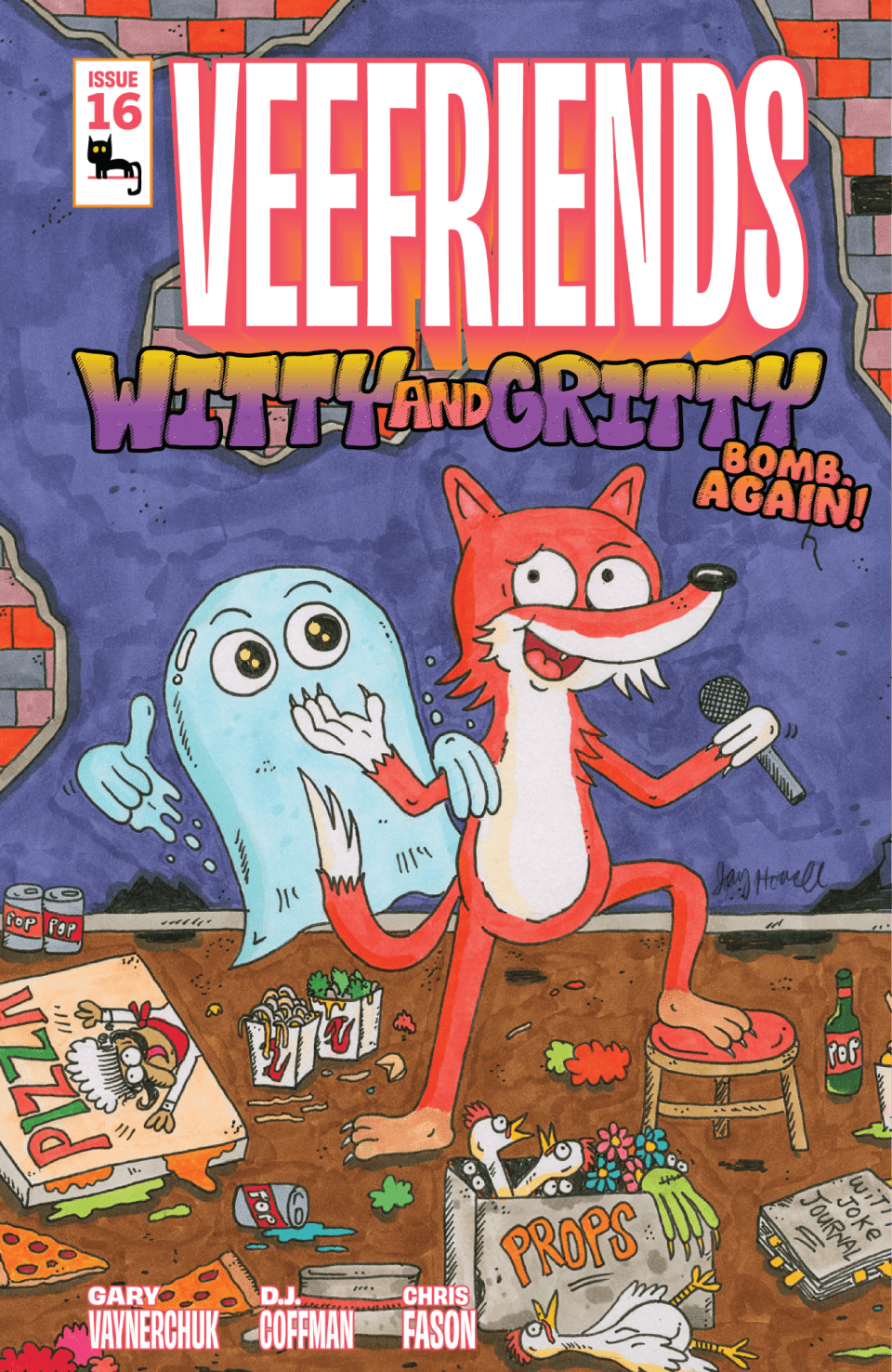
Issue 16 also has a completely different Cover B by Jay Howell, the original character designer for Bob's Burgers and the co-creator, art director, and executive producer of Sanjay and Craig. Howell's version is looser, stranger, and more chaotic than Cover A. Witty has the microphone, Gritty is literally hanging off him, and the floor is buried in pizza, soda, props, flowers, rubber chickens, and a notebook labeled "Joke Journal." It feels like the entire issue got dumped onto the comedy-club floor.

The Collector Pack created its own weird Issue 16 story after release. VeeFriends explained that white ink from Covers A and B transferred onto some of the black bags during heat sealing, leaving a faint outline on the outside. The comic inside was fine, but the "gas ghosting" could weaken the whole point of a blind bag by giving away which cover was inside.
VeeFriends paused sales, reheated the remaining packs to remove the effect, and said every customer who already bought one would automatically receive an additional sealed pack one-for-one. A ghosting problem on the Gritty Ghost issue is almost too perfect, except this one cost VeeFriends an extra comic pack for every original purchase.
After The Issue

Inspired by how VeeFriends treats character traits as forces that shape reality, I created Alien Traits: a 1-of-1 NFT series interpreting each of the 251 core traits. No repeats. Each visual piece also includes a written definition of the trait it represents in OpenSea's "About" section.
Explore the full Alien Traits collection here: https://opensea.io/collection/alien-traits
Character First Appearances
- Witty Weasel
- Gritty Ghost
Gritty Ghost appeared earlier in VeeFriends webcomics, including Job Opening. Issue 16 is still his first appearance in the main VeeFriends comic-book series.
Easter Eggs
1. The apartment number is 5G. Because this is VeeFriends, the 5 immediately catches my eye. GaryVee's favorite number is 5, and the G could be a little Gary nod, a tiny 5G phone-era joke, or nothing at all.
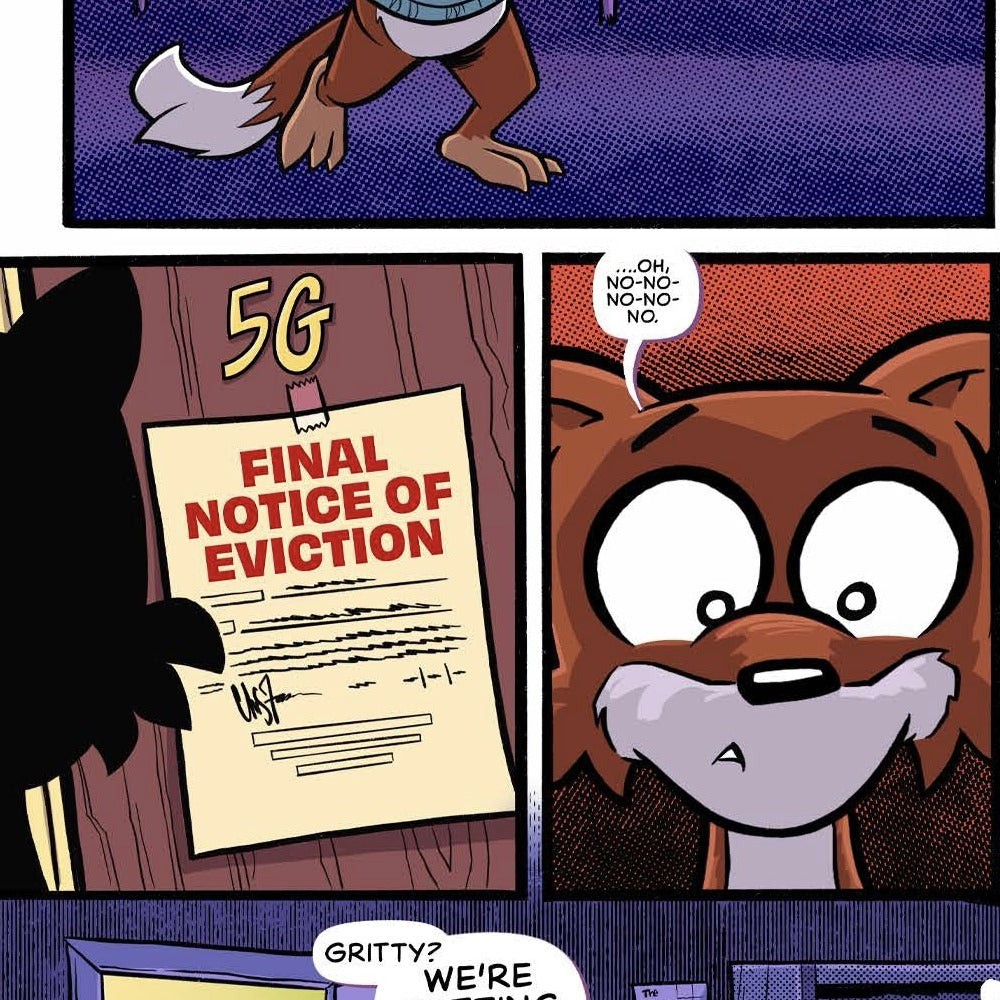
2. The Big Big Show poster is hanging in Witty and Gritty's apartment while Witty is discovering that they are being evicted. Earlier, Witty told Skip that his dream was to make it to the Big Show in New York City. By the end of the issue, Tokyo Joe's tour poster lists The Big Big Show as the tenth and final stop. Witty's destination is literally hanging on his wall during one of his lowest moments, then becomes the final stop on a real tour he has to work his way through. I still read the name as living somewhere near Saturday Night Live, a major comedy break, and New York entertainment mythology, but the comic has not confirmed one exact real-world show.

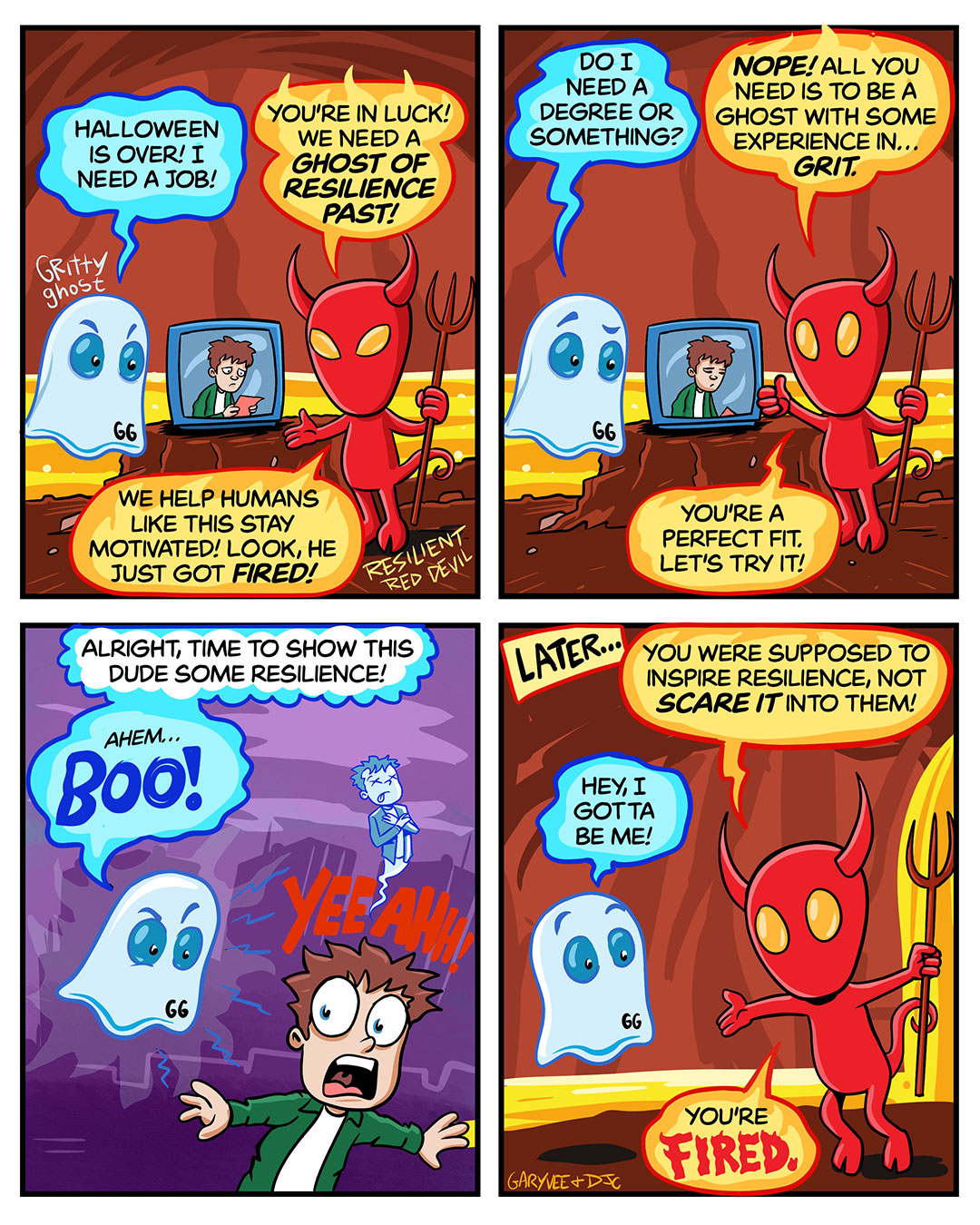
3. On November 1, 2024, VeeFriends published Job Opening, an early Gritty Ghost webcomic appearance that already puts him next to someone who got fired from his job. In that comic, Gritty is supposed to help a fired human stay resilient, but he scares the guy instead. Issue 16 gives Gritty another fired-job story, this time beside Witty after Witty loses his job the same morning his comedy dream starts falling apart. Maybe that parallel is intentional. Maybe it is the perfect coincidence. Either way, it is too specific not to notice.
4. The prop boxes are labeled Pop 'N Lock Props LTD, which reads like a joke on "Pop, Lock & Drop It." The song is by Huey, released in 2006 from his debut album Notebook Paper, and it became his signature hit. The same image also shows a partially blocked Farm Fights poster behind Gritty, connecting the apartment background back to VeeFriends Issue 13.
5. The Open Mikes crowd appears to include a wrestling-mask character, which feels like another Farm Fights echo. The same crowd area also appears to show Organized Ostrich, based on the long neck and bird shape. Both remain visual reads rather than confirmed cameos.
6. On Is It Canon?, Tom spotted that the poster beside the shadowy figure could be pointing toward Carrot Top: there is a carrot above what looks like a spinning top. Carrot Top is one of the most famous prop comedians, so the possible reference fits an issue already dealing with props, prop comedy, and whether Witty should change his act. I am not calling it confirmed, but I do not think the visual is random enough to ignore.
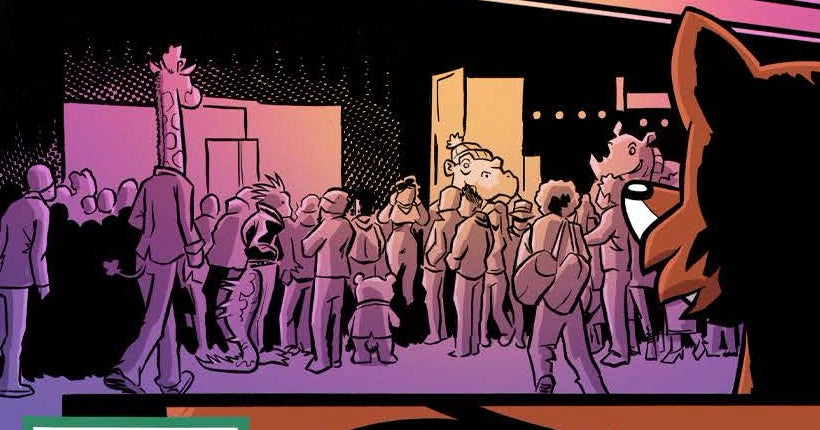
7. Tokyo Joe's crowd is packed with possible VeeFriends cameos. Genuine Giraffe is the easiest one for me to see, and I can also make out shapes that look like Helpful Hippo and Reflective Rhinoceros. On the left, there is a smaller animal character who may be a raccoon, but the panel does not show enough detail to identify it confidently. Farther right, what looks like a human-sized iguana is standing beside the people in line like there is nothing unusual about it. None of those identities are confirmed, but the mix is another example of humans and animal characters sharing this world without anyone stopping to explain why.
A few pages later, there appears to be a robot in the audience. On the following page, a black silhouette with huge yellow eyes is hiding behind Witty and Gritty. Those eyes immediately make me think of Black Cat, especially because Black Cat is the icon printed beside the Issue 16 number on the cover. The body is mostly hidden, so I am keeping both of these in the possible-cameo pile rather than calling either one confirmed.
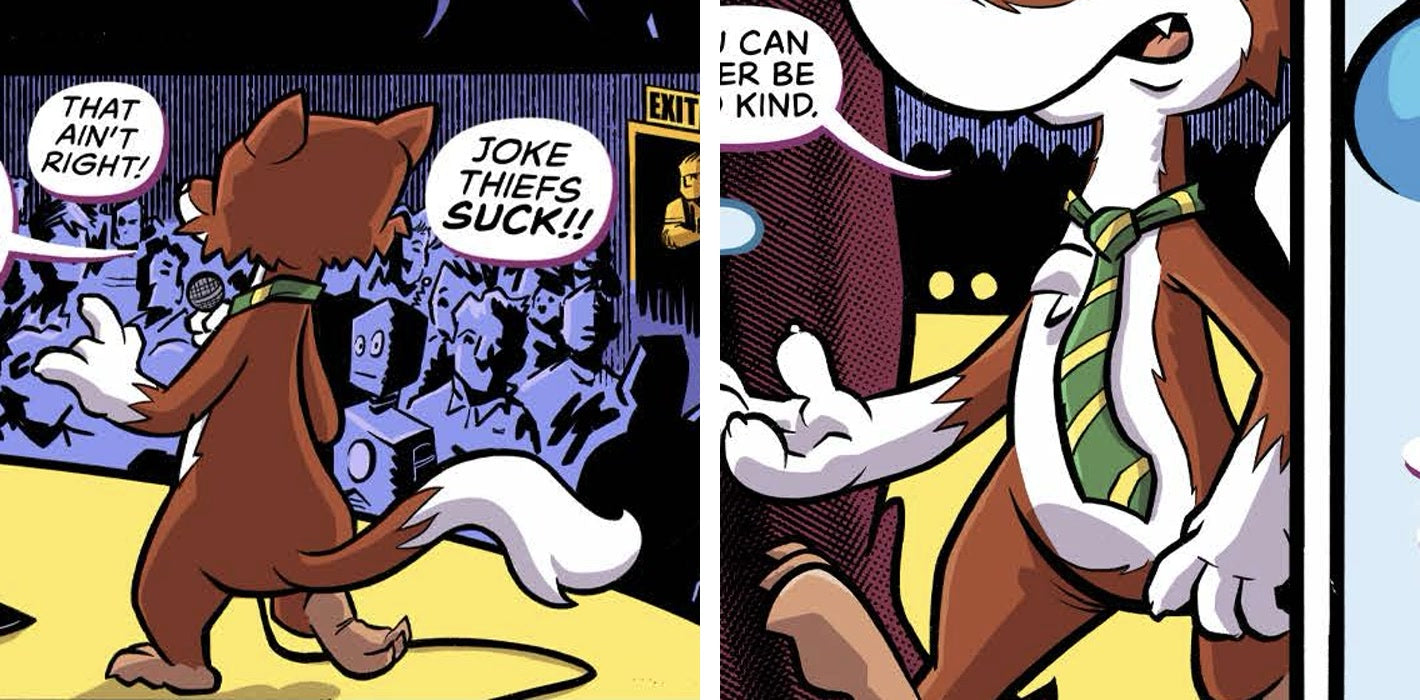
8. Tokyo Joe's license plate says "MICDROP." That one is pretty straightforward for a car carrying two comedians on a ten-stop tour, but it is still a perfectly placed comedy Easter Egg.
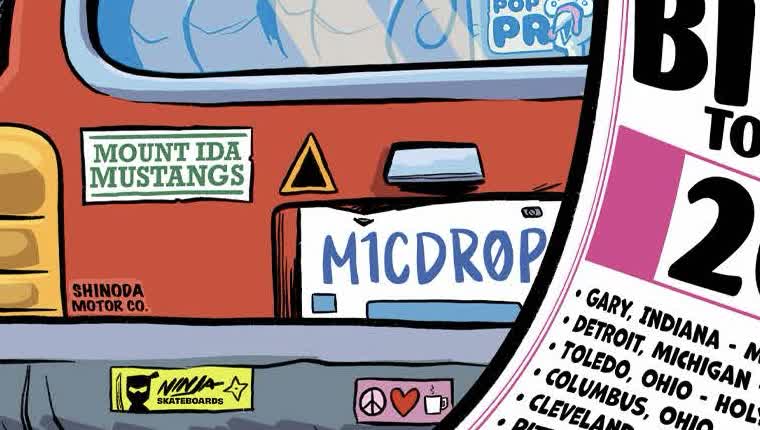
9. The Mount Ida Mustangs sticker goes deeper. GaryVee attended Mount Ida College, and the school's athletic teams were the Mustangs. Mount Ida is also an official VeeFriends Series 2 scene. To be exact, the NFT scene is named "Mount Ida," not "Mount Ida Mustangs." The bumper sticker pulls Gary's real college and mascot into the comic while also pointing to a place that already exists in Series 2.
There is even a Gritty Ghost Series 2 NFT set at Mount Ida, so the connection comes right back to the character riding in this car.

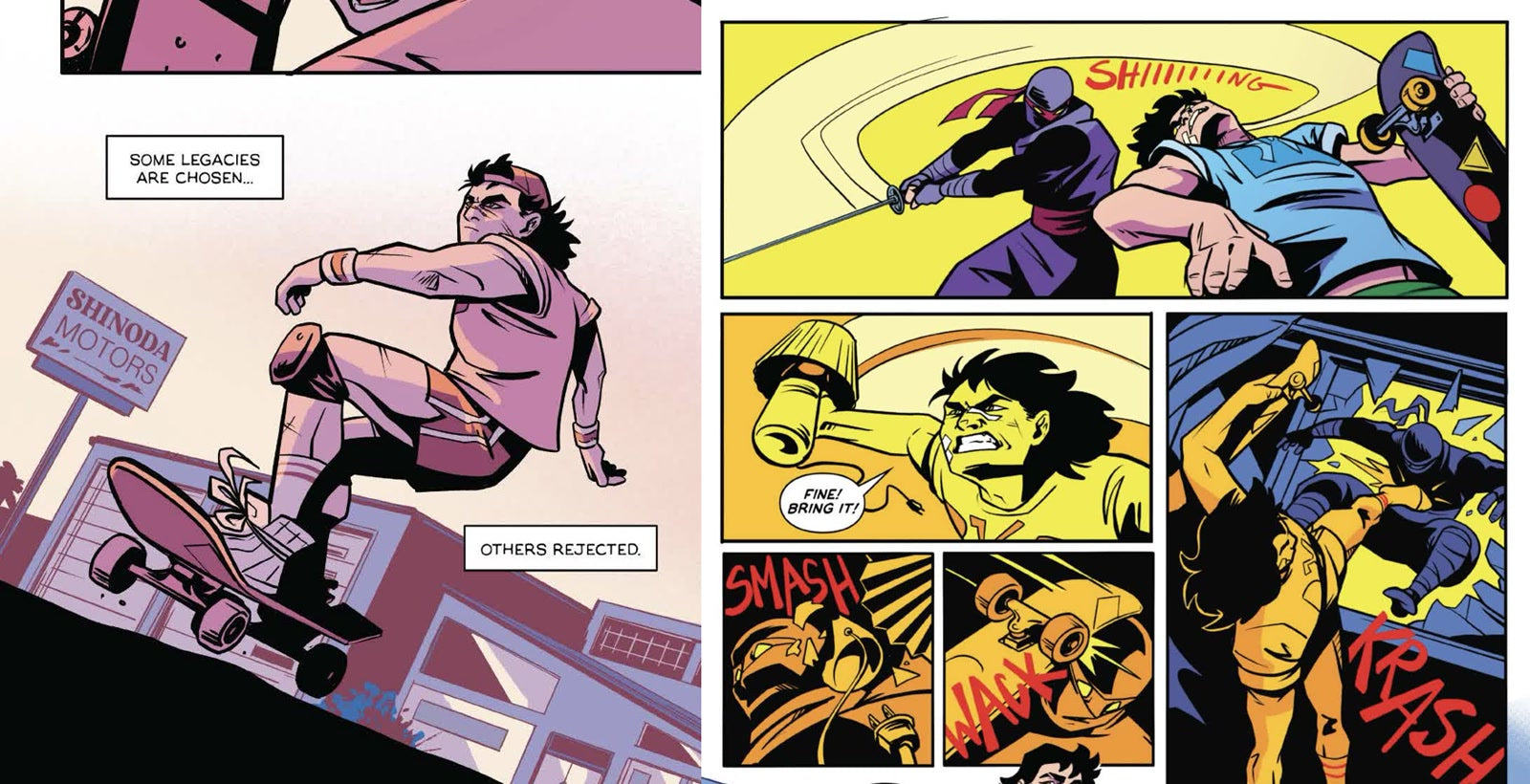
10. Ninja Skateboards and Shinoda Motor Co. are both direct Issue 07 callbacks. Before Renji Shinoda becomes Notorious Ninja, he is a 16-year-old skateboarder trying to build his own life. Shinoda Motors is his family's dealership, where Uncle Lou tells him the legacy he is inheriting is not the business. It is Notorious Ninja.
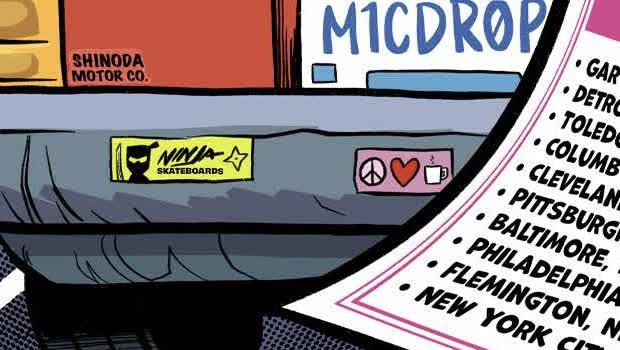
The stickers split Renji's story into two pieces and park both on Tokyo Joe's bumper: Ninja plus skateboards, then Shinoda plus motor company.
11. Tokyo Joe's tour poster turns the road to New York into a city-by-city joke list. Some of these are direct local references. Some are strong possibilities. One is physically cut off by the curl of the poster, so I am leaving it cut off instead of finishing the joke for the comic.
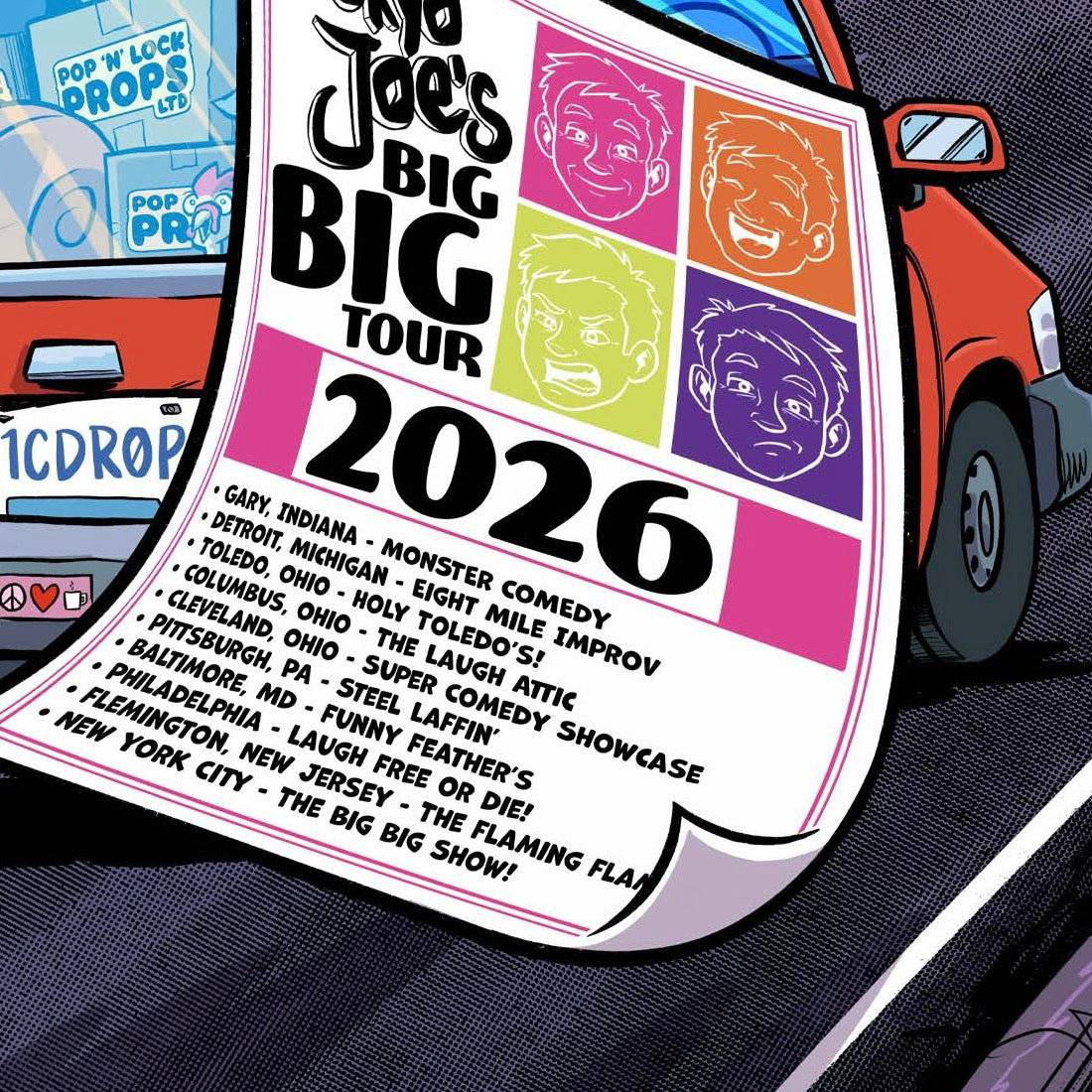
Gary, Indiana gets Monster Comedy. That one goes straight back to VeeFriends Issue 05, which takes place in Gary and turns Larry and Garry Loserson into Motivated Monster. Witty is starting his tour in the same city where VeeFriends already created a monster.
Detroit gets Eight Mile Improv. 8 Mile Road and Eminem's 8 Mile are inseparable from Detroit, and the movie follows a performer trying to break through. Swapping rap battles for improv makes the name fit Witty's tour almost too perfectly.
Toledo gets Holy Toledo's! The exact origin of the phrase is still debated, but Toledo has embraced "Holy Toledo" as part of its local identity. Columbus gets The Laugh Attic, and Columbus has a real Attic Comedy Club. The comic appears to have added "Laugh" and turned a real local club name into a fictional stop.
Cleveland gets Super Comedy Showcase. Jerry Siegel and Joe Shuster created Superman in Cleveland, so "Super" is doing more than advertising a large comedy show. Pittsburgh gets Steel Laffin', a direct play on Pittsburgh's Steel City identity. Tom also caught on Is It Canon? that Pittsburgh is D.J. Coffman's home turf, giving that stop both a city joke and a possible creator connection.
Baltimore gets Funny Feather's. My first thought is the Baltimore Ravens, whose name comes from Edgar Allan Poe's "The Raven". A feather is broader than a raven, so I am keeping that as a likely Baltimore joke rather than calling it confirmed.
Philadelphia gets Laugh Free Or Die! That bends New Hampshire's official "Live Free or Die" motto into a comedy-club name, while Philadelphia's Declaration of Independence history gives the word "Free" a second local reason to be there. The original motto does not belong to Philadelphia, so I read this as two American freedom references colliding in one joke.
Flemington is the only stop the poster will not let us finish. The visible name is "The Flaming Fla..." and then the paper curls over the rest. My best guess is The Flaming Flamingo. It fits the letters we can see and sounds exactly like a VeeFriends comedy club, but the curl hides too much for me to call it confirmed.
New York City gets The Big Big Show, the destination Witty has been chasing throughout the issue. It still lives somewhere in my SNL, major comedy break, New York dream zone, but the comic has not confirmed one exact real-world show. After nine city jokes, the tenth stop stays focused on Witty's fictional finish line.
12. Tom and Ann noticed on Is It Canon? that the landlord's signature on Witty's eviction notice looks a lot like artist Chris Fason's autograph. I can see why they read it that way in the enlarged crop, but the mark is too stylized for me to call it confirmed. If it is his signature, Chris did not just draw Witty's eviction. He signed himself into the story as the landlord who delivered it.
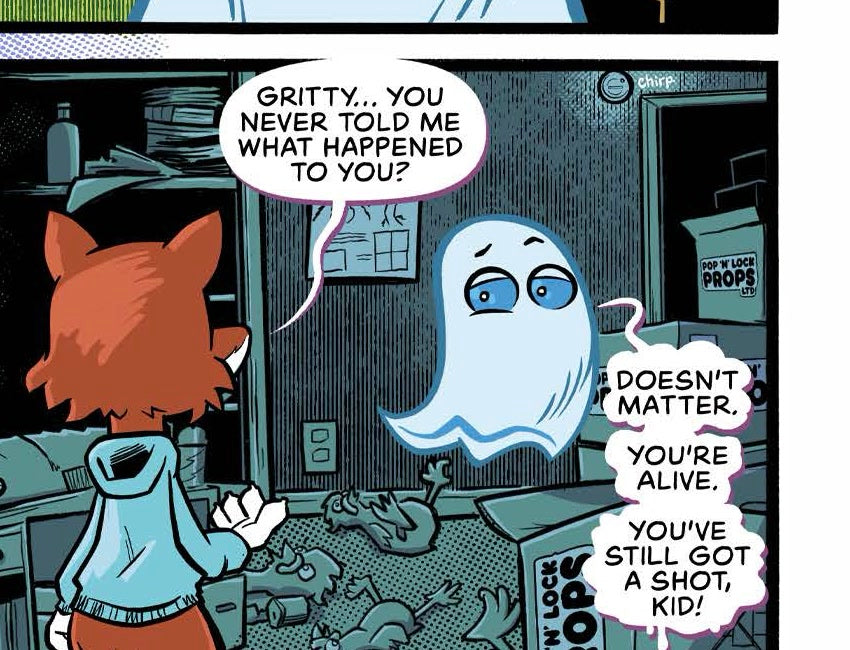
13. The smoke alarm above Witty and Gritty has a tiny "CHIRP" beside it, which usually means the battery needs to be replaced. At minimum, it is another detail showing how broke and neglected the apartment has become.
But there is a darker comedy reference here that I do not want to dance around. The smoke-detector chirp is also a very common meme built around the stereotype that Black people do not change the batteries in their smoke alarms. Sometimes the joke gets widened to poor people in general, but usually the punchline is Black people. It is a racist joke, even when somebody uses the chirp like a harmless little sound effect.
On Kill Tony, Brian Redban has played that exact low-battery chirp while Kam Patterson is onstage, including in Episode 691. That does not prove D.J. Coffman or Chris Fason intended the same joke here. The "CHIRP" could simply be there to make Witty and Gritty's apartment feel even more neglected. Still, this is an entire comic about comedy, and the reference is close enough that I think it belongs in the conversation.
Up Next
Continue with VeeFriends Issue 17 Explained: Prophecy, Persistence, and Why Nobody Gets There Alone.
Read all VeeFriends Comics Explained posts here: https://www.alieninks.com/pages/veefriends-explained?view=veefriends-explained-dynamic-v2
Reader signal
Comment on the decode
Share what you caught, what you disagree with, or what you want Ian to unpack next. Comments post to this article thread.
0 comments