

Farm Fights! began as a hand-made mini-comic giveaway for New York Comic Con. It was created solely and entirely by artist, writer, and comic industry titan Jim Rugg, who is now part of the VeeFriends Comics team.
What makes this issue stand out immediately, and something worth calling out before anything else, is that Farm Fights is a fully realized vision from Jim Rugg. This was not just another contribution to the VeeFriends comic line. Rugg conceived the concept, wrote the story, illustrated every page, and originally created the Farm Fights mini-comic that this issue is based on before officially joining the VeeFriends team. That level of singular authorship is rare in this series, and you can feel it in the cohesion of the tone, pacing, and visual identity. Whether or not every narrative beat lands for you, there is a clear creative throughline here that separates Issue 13 from anything that came before it.
The Farm Fights! mini-comic is a prequel to VeeFriends Issue 13, and reading it is crucial to understanding the correct framing and backstory of the main issue. What I find unfortunate is that this prequel, which does enhance the read of VeeFriends Issue 13, was not available online prior to the release of the main issue. In other words, the majority of readers will not understand the context of the story they are reading until they get to the end of it.

Thankfully, a full reprint of the Farm Fights! mini-comic is included at the end of VeeFriends Issue 13. So this is an easy problem to solve. If you have not already read this issue, my recommendation is to start by flipping to the end, reading the Farm Fights! mini-comic prequel, and then returning to the first page of the story.

To summarize, the Farm Fights! mini-comic teaches us a few key details. The first wrestling match we see is between Mojo Mouse and Bullish Bull. At this point, it is simply a friendly and athletic way for the animals on the farm to pass the time. It is all in good fun. Then a conflict is introduced. Fantastic Farmer, the apparent owner of the farm, had a poor harvest this year. As a result, he is worried he will fail to pay his bills and ultimately lose the farm to foreclosure.
Their brilliant idea to save the farm is to convert their friendly “rassling” pastime into a profitable spectacle. They decide to call it Farm Fights, and that is the backstory readers should be aware of as they begin reading VeeFriends Comic 13.

From the first panel of this issue, you can tell that the style and vibe are cartoonish. The setting appears to be within VeeWorld, as we see both humans and animals entering the barn where the fights are being held. So far, we have only seen anthropomorphized animals, or in other words animals with human characteristics, within VeeWorld, hence the guess. At the front of the barn is Hype Horse with a bullhorn, excitedly promoting the event.

This is the first time we have been introduced to Hype Horse, one of the 251 Series 2 VeeFriends characters, as VeeFriends Comic 13 boasts the inclusion of 11 first appearances.
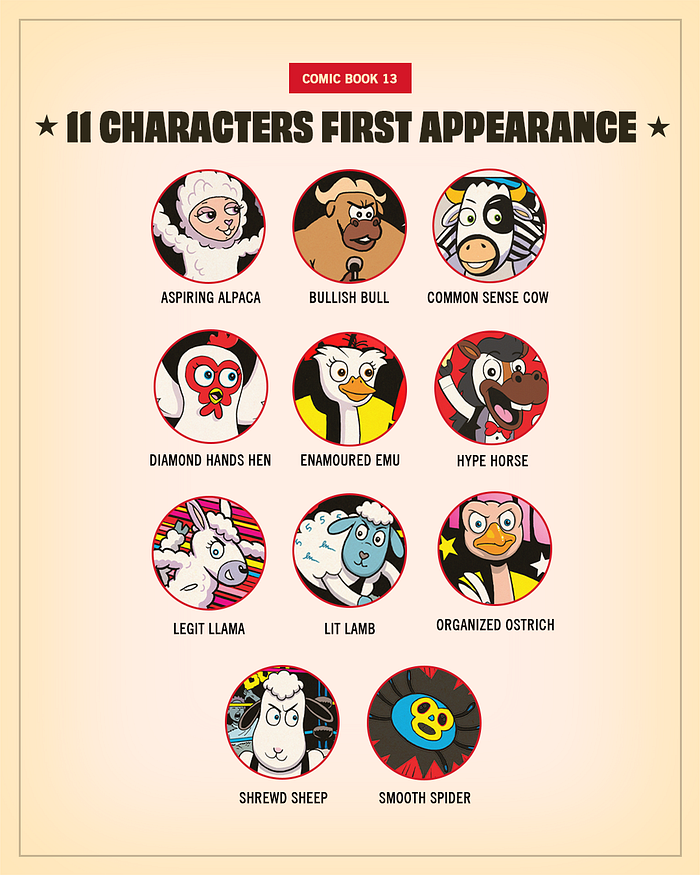
Personally, I disagree with the way the term “First Appearance” is used here, given that one of these supposed first appearances includes Mojo Mouse. Mojo Mouse appears in the Farm Figths! mini-comic but that isn't an official canon comic to my understanding, so I see why that one does not count. But that's not the issue.

According to VeeFriends’ own website, Mojo Mouse was already featured in VeeFriends Comic Issue 02. So how could he be “first appearing” in VeeFriends Comic 13?

I looked further into this, and apparently this is a hotly debated topic within the comic world and community. However, there is some consensus that Mojo Mouse’s feature in VeeFriends Comic 02 would be labeled a “first cameo appearance,” given that he did not have any speaking lines, was not referred to by name directly, and only appeared in a couple of panels. In VeeFriends Comic 13, Mojo Mouse has what would be called a “first full appearance,” meaning that he is more relevant to the plot, is directly named and mentioned, has speaking lines, and appears for more than a few panels.

The criteria are not an exact science, but this helps clarify that when VeeFriends markets this indiscriminately as the “first appearance” of Mojo Mouse, they really mean “first full appearance” and not “first cameo appearance.” Personally, I think they should make that clarification overt by always using one of those two terms instead of ambiguously shortening them to simply “first appearance,” but that is just this Lore Master’s opinion.

Speaking of lore mastery, I did not feel there was all that much for me to go over in this one. Mainly, there are 11 characters living on a struggling farm with Fantastic Farmer, where they all either wrestle or participate in wrestling event production to make enough money to keep the farm alive. Obviously, we will still break down the issue, but mostly VeeFriends Comic 13 is a visual experience. While it does feature the first full appearances of 11 VeeFriends Series 2 characters, along with the inclusion of Paper Hands Pony from the Book Games Tokens, VeeFriends Comic 13 does not add significant layers of depth to any of these characters.

In the first match, Mojo Mouse defeats Smooth Spider. The issue then cuts to Mature Mule as an announcer. Mature Mule is attempting to interview Organized Ostrich, who is a wrestler, before his manager, Diamond Hands Hen, abruptly steals the microphone. What stands out to me here is how well Common Sense Cow fits as a referee, Hype Horse as a promoter, and Mature Mule as an announcer. Their traits are well reflected in their roles, and it is reassuring to know these choices are being made thoughtfully and intentionally.

Up next is a wool-versus-wool match. It is Shrewd Sheep and Lit Lamb against Legit Llama and Inspiring Alpaca.

Again, there are a few Easter eggs throughout this issue, which are covered at the end of this article in the Easter Eggs section. For now, enjoy the artwork and story in the panels. This issue is rather straightforward.


 Apparently, there was a bet riding on this match. Aspiring Alpaca explains that she did not want to get sheared and apologizes. But she is apologizing for more than we realize.

Aspiring Alpaca was conspiring with Lit Lamb and Shrewd Sheep to throw the match. I wonder if this is a commentary on the trait Aspiring as a whole, or what this decision says about the moral fiber of this character. People can make questionable decisions while aspiring toward their own versions of greatness.

The final match is the headliner: Organized Ostrich against Enamoured Emu.
I have always thought it was interesting that they spell “Enamoured” with a “u” here, which is common in the UK but not in the US. Was that an intentional decision? Was it Gary’s decision? As Enamoured Emu enters the ring, he is accompanied by his manager Diamond Hands Hen. I had to double-check whether emus are actually farm animals, but apparently the answer is yes. Who knew?

After the match starts and the action is underway, we see a panel where Diamond Hands Hen trips Organized Ostrich. Does wrestling breed immorality and rule-breaking? Is it all part of the show? To me, this seems like something a manager should know not to do, because it could potentially get their fighter disqualified. If Diamond Hands Hen is a decent manager, why would he risk that? It fits with the shenanigans of professional wrestling and WWE. But in those, everything is pre-planned and scripted. I cannot tell yet whether these characters are experiencing genuine beef and betrayal, or if it is all part of the show. But it seems real.

Organized Ostrich gets so angry that he leaves the ring. No call of “fowl” play from Common Sense Cow? Is that a reminder that the E in WWE stands for Entertainment? I would say maybe the ref did not notice, but it was announced. So why not call a penalty for a manager getting involved in a one-on-one match? Unless it really is all part of the entertainment? Continuing to say nothing about the transgressions of Diamond Hands Hen, the ref starts the ten count in favor of Enamoured Emu, effectively penalizing Organized Ostrich for leaving the ring too long.

But Organized Ostrich makes it back into the ring just in time to beat the count and jumps right back into the action.

But is it enough to win the match?

Yes, it is. Despite the unpenalized cheating antics, Organized Ostrich wins the match. Enamoured Emu ultimately loses his belt to the new champion. Hype Horse attempts to interview Organized Ostrich, as is standard at the end of the match, but before a single question gets answered...

Bullish Bull lays down the smackdown along with a challenge. He is coming for the belt. My first thought is that there is no way they could be in the same weight class. But again, they are clearly wrestling for entertainment in a way that parallels what we see in the real world.

As all the wrestlers gather in friendship on the last page after the matches are over, we get confirmation that all the antics were part of the theatrics of the show. Legit Llama is smiling and sitting next to Aspiring Alpaca. Bullish Bull is sitting peacefully across from Organized Ostrich. They made enough money to save the farm, and everyone is happy and on the same team in the end.
VeeFriends Issue 13 ultimately functions less as a lore-heavy expansion and more as a proof of concept for how this world can stretch into different genres without losing its core identity. What begins as a simple, almost playful wrestling premise reveals a deeper throughline about survival, adaptation, and collective effort under pressure. The farm only survives because every character leans into their role, not perfectly, but effectively enough to create something bigger than the sum of its parts. The theatrics, betrayals, and exaggerated personalities are not contradictions of the VeeFriends ethos, they are extensions of it, filtered through the lens of entertainment. And that is the real takeaway. Not every story needs to deepen the mythology to move the universe forward. Sometimes expanding tone, format, and possibility is the evolution itself, and Issue 13 proves that VeeFriends is not confined to one type of story, but capable of becoming a platform for many.
After The Issue

If what resonated here wasn’t just the review, but the way identity, intent, and character traits were treated as forces that shape reality, that same line of thinking didn’t stop with this article.
Inspired by how VeeFriends treats character traits as forces that shape reality, I created Alien Traits: a 1-of-1 NFT series interpreting each of the 251 core traits. No repeats. Each visual piece also includes a written definition of the trait it represents in OpenSea's "About" section.
It isn’t VeeFriends art. It’s a parallel conversation with the ideas underneath it.
Explore the full Alien Traits collection here: https://opensea.io/collection/alien-traits
Easter Eggs
1. Gritty Ghost Hat: This character is wearing a Gritty Ghost hat, which is an actual representation of existing VeeFriends merchandise in our real world. I actually gave one to Joe McDoe for being the largest whale holder of my Alien Traits NFT project at the time. Now, Gary Vee is the largest holder of Alien Traits with Joe McDoe and Jeremy Knows tied for second!

2. We see a tiger and several other animals. Some of which appear to be characters we know such as Tremendous Tiger, Decisive Duck, and Boisterous Beaver. Maybe even Gracious Grizzly Bear. Then we see the brown cow and the pink rabbit and we are reminded, as we were above with the Mojo Mouse explanation, that in the comic world there is a difference between first cameo appearance and first full appearance. Just because these characters look like our beloved VeeFriends doesn't mean they aren't random animals. And, even if that is Tremendous Tiger, this would still only be a first cameo appearance and not a first full appearance. 
3. Paper Hands Poney makes a first appearence as he switches his prize fighter rider from Smooth Spider to Mojo Mouse after the results of the match have been announced. But Paper Hands Pony is not one of the 251 VeeFriends Series 2 Characters, he is a Book Games Token. If you don't know what Book Games are in the VeeFriends ecosystem yet, I highly recommended adding it to your to-do list to find out. 

4. Why is a beach ball on a farm and getting tossed around amongst the crowd as they enter the barn? I have seen bring beach balls to concerts before and bop them around amongst the crowd inside the venue. Never at a farm fight. But perhaps this is a parallel to that idea and there's a first for everything.

5. Buffer Reference?
According to Google AI:
The character is definitely a nod to the iconic ring-announcing style of Bruce Buffer and his brother Michael Buffer. Here’s why:
The Look: The horse is wearing a classic tuxedo with a bowtie, which is the standard "uniform" for professional ring announcers like the Buffer brothers.
The Dialogue: The phrasing "Scheduled for one fall with a 20 minute time limit" is a classic line used in professional wrestling and boxing matches to set the stage before the announcer's big introduction.

6. There is a Cynical Cat logo on this fan's tee shirt.

7. Gracious Goose and Patient, who were in the Farm Fights! mini comic make a first cameo appearance, not a first full appearance, in Issue 13.

Up Next
The next VeeFriends Explained breakdown is still coming. For now, return to the VeeFriends Explained archive to keep reading the series.
Reader signal
Comment on the decode
Share what you caught, what you disagree with, or what you want Ian to unpack next. Comments post to this article thread.
0 comments