On a January 25, Whatnot stream, Andy asks D.J. Coffman about what the skull on the front cover of the issue means. In response, D.J. confirms there is something there. He concedes that it is not a random detail but doesn't divulge the explanation. Andy then literally asks me, KOWSKY, to help. He says, "KOWSKY I need you on this brother, I need you, 10 hours of homework, what is D.J. doing here with this cover?"
In VeeFriends Issue 01, the first line on the first page explains, "It's easy to fall into stories designed to divide us... Good vs Evil. Red vs Blue. We're better when we work together for a greater good. To get there, we need to find the balance in the middle."
Although Rare Robot is not purple but rather constructed from a self-sustaining blue alloy, in the cover, he is clearly still representing the balance between the Red and Blue skulls he stands upon, which is what D.J. was telling us. But if that's what he was willing to causally divulge, what is the rest of the secret he is holding back here?
Probably like yourself and like many of us, I did not think anything of this poster when I first read VeeFriends Issue 01. I also didn't think about it when I saw the Jim Mahfood cover of VeeFriends Issue 04. Of course, I noticed that in his variant, Thoughtful Three Horned Harpik is standing on a mysterious skull that we have never seen as a VeeFriends association before. I wagered it was included as an element of Jim Mahfood's personal style that didn't have a direct canonical VeeFriends tie in. This seemed logical because the nature of cover art variants in for them to do exactly what I am describing and take creative liberties that cater to the creatives creating them. But now, with the release of VeeFriends Issue 10, I am starting to connect the dots.
I have a personal saying that goes, "Once is an occurrence, twice is a coincidence, and three times is undeniably a pattern. Three points is also the minimum number of points needed to graph a parabola." It's probably cleaner without the second line about math but I always include it so I won't shorten it here for convenience at the cost of being authentic. If we count the skull from VeeFriends Issue 01, this is the third skull appearance we have seen in only 11 official Issues.
By my rules, this is now an undeniable pattern. That said, even though we theoretically have enough points to graph the parabola, I don't have enough info to fully resolve the meaning here. But I do have enough to guess. And I welcome everyone reading this to guess along with me. As always if you contribute anything of value, I will add it to the article and credit you. However, the conclusion I come to about these heads is one I don't come to until I reach the end of the article. So, let's start properly from the beginning and work our way to the epic epiphany in the ending.
A Pile of Scrap Metal

The issue opens with a pile of broken parts, all heaped together into a mountainous wreckage. There is so much going on here. So let’s touch on all of it, and I’ll do my best not to go overboard.

What jumps out at me first is the purple and pink structure on the left, something longtime viewers of the VeeFriends YouTube series will immediately recognize. At first glance it resembles a helmet, but it is not wearable armor. It is the large hovering apparatus Balanced Beetle uses as his floating announcer platform inside the VeeDome. It moves around the arena as he broadcasts, functioning more like a mobile command pod than protective gear. Its presence here feels intentional, a clear visual callback that pulls the animated series directly into the broader continuity.
I have not seen it formally confirmed whether the VeeDome cartoons are considered canon. Regardless, the creative team is unmistakably integrating elements from that series, particularly the VeeDome itself, into this official issue. Whether labeled canon or not, the bridge is being built on the page.

Next, what immediately catches my attention is what appears to be the helmet from VeeFriends Issue 01. The same helmet that amplifies the intent and energy of its wearer, whether positive or negative. The same helmet Balanced Beetle places into a glass containment unit at the end of Issue 01. We know that VeeFriends Issue 10 is set 555 years in the future, but exactly what that carries with it is unclear. The question becomes: what happened between then and now for such a sacred, pivotal, and dangerous artifact to end up discarded in a pile of scrap?

Toward the top of the heap, one helmet loosely reminds me of Heart Trooper. Where exactly have we seen this helmet before...

This entire scene strongly reminds me of one of the early VeeFriends webcomics titled The Secret Origin Story of the Heart Trooper.
Toward the bottom right, another evokes Vision from the Marvel universe. On the bottom left is what I would confidently identify as the helmet of Adventurous Astronaut, complete with what appears to be a bullet hole. That detail introduces a dark, foreboding undertone, though it could also be an intentional jump-scare tease rather than a literal implication.
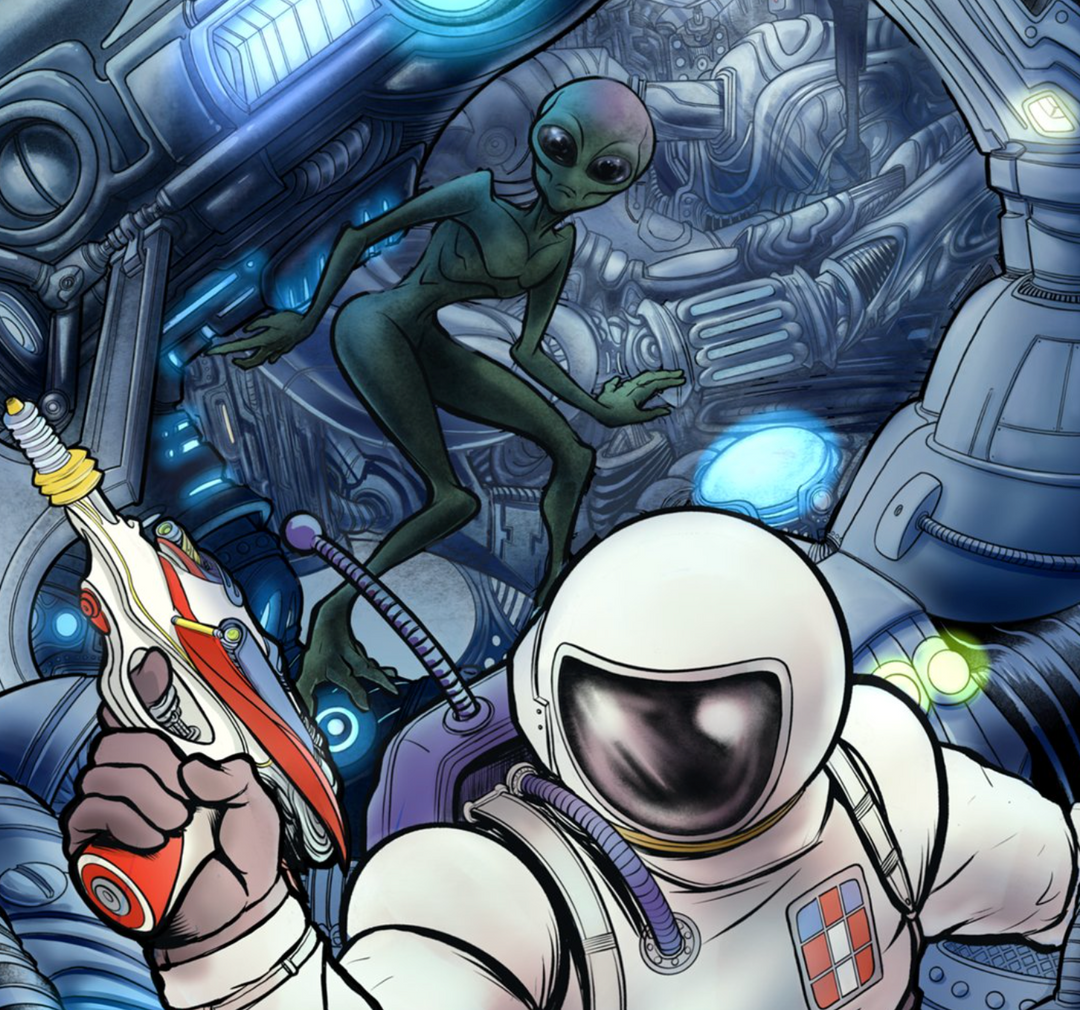
At the time of writing this, Issue 11 has not yet been released, but it is starring Adventurous Astronaut and Adaptable Alien, so we may soon get clarity. There’s obviously far more embedded in this debris pile, but I’ll stop here, except to say this: I would not be surprised, and in fact I would wager, that many of these scraps are not random at all. I suspect they will eventually connect to future stories in ways that only become obvious years from now, once the full VeeFriends narrative arc is revealed.

Lastly, of course, we see Rare Robot’s head in the pile. A few humanoid beings called Organiks are about to discover it and reassemble him to get this whole thing started.
Putting Rare Robot Together Again
As I was saying, a couple of humanoid beings known as Organiks find Rare Robot’s pieces and assemble him back together, effectively bringing him back to life, despite attaching the wrong right arm in the process.

When Rare Robot awakens, the screen on his chest begins playing a historical video. It explains that Rare Robot comes from a past where humanity reached the brink of armageddon due to the emergence of AI, but ultimately found a way to work in harmony with it. Together, humans and machines achieved a global utopia so complete that humanity actually rebranded the Earth itself as Utopia.

In one of these flashback panels, we see a man wearing glasses that are identical to those worn by Willful Wizard.
What?
This moment made my brain absolutely short-circuit.
That same man is also shown wearing a helmet in what appears to be a political or public setting, where no one else is wearing one. What could this possibly mean? It’s so far left-field that I don’t yet have a working theory. But this is a clear note-to-self moment. This detail demands future analysis, research, and contemplation.

In another flashback panel depicting a utopian cityscape, we see Rare Robot walking through the city. Behind him is another robot that looks nearly identical, with a few subtle differences and a red-and-yellow color scheme instead of blue and orange. In that same panel, we see flying cars and a futuristic skyline, making it clear that Rare Robot’s origin point is far beyond the future of 2025, where Issue 01 begins. Issue 10, by comparison, appears to be set vastly further ahead still.
Abruptly, while the video is still playing, one of the Organiks smacks Rare Robot, stopping the playback and calling it brainwashing propaganda. The two Organiks begin interrogating him. Rare Robot explains that he runs on positive energy and asks them if they want to hear his theme song.

He offers two options.
Yes?
No?
These are the same two options featured prominently on the base cover of this issue, which makes this moment especially significant. I read this as a direct reference to binary, the foundational language of computing, built entirely on ones and zeros. At its core, binary is a system of yes and no, on and off. This feels like a subtle computing knowledge nod that many readers may not consciously register, but it’s absolutely there.

Speaking of nods, the reference to the theme song itself is a deep cut for OG members of the VeeFriends community. The Rare Robot song was one of the earliest pieces of character-based IP the brand ever released. It was a music video with a scrappy, startup-era, low-budget feel, but it functioned as an anthem, a theme, and a rallying cry at a time when the community was starving for content. A time when all they had were Gary’s original hand-drawn Series 1 sketches and dreams of the future.
As a result of this issue, Rare Robot now has a new official theme song video on YouTube.
Testing All Systems
The male Organik says no. The female Organik says yes.
The male insists that Rare Robot is nothing more than a toy. The female immediately contradicts him, explaining that Rare Robot is actively transmitting a distress signal, even though Rare Robot himself denies doing so.
Then, abruptly, the discussion is interrupted.
Rare Robot receives an incoming signal from the past, informing him that his help is needed in 2025.

Instantly, he teleports, or whatever the correct term is here, his consciousness back into his 2025 vessel and appears to completely shut down.
Woah.
This is Rare Robot traveling back to the events of VeeFriends Issue 01. Unreal. What a connection! These are the moments that fill me with joy and gratitude for the mind of D.J. Coffman. I mean I'm sure Gary plays a major role as well. But when I see this type of connection I personally always think of DJC.
In a single beat, several massive things are confirmed.
First, Rare Robot is not bound by the confines of space or time. Second, his method of time travel does not involve a physical time machine, nor does it require his body to move at all. Only his awareness, his consciousness, travels. And while that consciousness is elsewhere, his physical body is left behind in a temporarily non-functional state, displaying an “808 Error” on his chest.

This is not a random number.
In Microsoft Intune, an 808 error typically indicates that a device is already registered in another tenant or still has a persistent record from a prior enrollment. Do you see the connection?
The error appears because Rare Robot is currently registered back into his 2025 “tenant”, his original body, causing a conflict with his present physical shell. As a career IT Support Technician myself, I absolutely appreciate this joke.

During this pause, the two Organiks deploy their “A-Eye” drone to scan Rare Robot for further information. The scan confirms that Rare Robot is a sustaining living alloy, powered by positive energy, which he absorbs through what the drone identifies as “unseen vibrational frequencies” generated by “emotional resonance.”
This immediately brings to mind the idea that what one civilization calls magic may simply be the most advanced form of science, perceived by minds that are not yet programmed to frame what they’re witnessing in scientific terms.
The drone also confirms that Rare Robot is using quantum communication to transmit across timelines.
It's A Matter of When
Let that land.
Back in VeeFriends Issue 01 Explained, I speculated that Rare Robot might effectively be a quantum computer. In VeeFriends Issue 10, that theory is no longer speculative. It’s confirmed.

The Organiks are visibly shaken by this discovery, because according to their understanding of science, this level of quantum technology should not exist yet.
And this is where my brain starts running simulations.
What if the way past and future are being presented to us, the audience, isn’t actually accurate? What if Rare Robot is not merely from the Organiks’ past, but from a future beyond theirs? What if the memories we’re shown and assume to be history are actually events that haven’t happened yet in the Organiks’ timeline?
If Rare Robot was sent backward, then what the Organiks are labeling as propaganda might not be fabricated history at all. It might simply be future truth they’re not temporally positioned to recognize yet.
And if that’s the case, then no one in the room realizes what they’re actually looking at.
Yet.

When Rare Robot awakens from his temporal excursion back on Burn Island, he scans that the two beings standing before him and sees that while superficially human in appearance, they are actually Organiks. Not people in the traditional sense, but something closer to machines. Synthetic beings with a severely limited lifespan of just five years, the result of their failure to solve their own species’ longevity problem.
Rare Robot explains that in his timeline, even humans can live 275 years and beyond. He then offers to help them solve their lifeline dilemma.
Yes?
No?

None of this makes any sense to the male Organik. According to everything he knows, humans and Earth are long gone, extinct after destroying themselves in a catastrophic event. Rare Robot calmly counters this belief with a simple but loaded line: “What you think you know may not always be.”
Think whatever you want, but to me, that’s confirmation.
This story is not just about character origins or distant futures. A core engine of the narrative is the manipulation, divergence, and traversal of timelines themselves, specifically through Rare Robot’s journey. What is remembered as history, dismissed as propaganda, or assumed to be impossible may simply be a matter of when you’re standing, not what is true.
And Rare Robot appears to be standing everywhere at once.
Danger, Rare Robot
That’s the breaking point for the male Organik.

He forcibly hauls Rare Robot away and locks him inside a cell sealed by a door resembling a Cynical Cat symbol, reporting Rare Robot’s presence to his superiors. The act feels less procedural and more reactionary, as if Rare Robot’s very existence has crossed a psychological line that cannot be tolerated.
The female Organik, noticeably more empathetic than her counterpart, tells Rare Robot that they are only locking him away to keep him safe. But that immediately raises a question. Is she lying to soften the reality of imprisoning him? Or does she genuinely believe there is some danger she’s protecting him from? And if so, what danger could that possibly be?
Either way, Rare Robot is completely unfazed.
“I promise I’m never in any REAL danger.”
In the comic, the word REAL is bolded.

That matters.
So let’s pause here.
I know we may already be pushing the mental bandwidth of the average reader. If you’re still with me at this point, genuinely, respect. Because this next layer asks for one more step forward.
Beyond timeline manipulation, beyond quantum travel, there is another reason Rare Robot knows he is not in any “real” danger. He appears to be self-aware of something the Organiks are not. Rare Robot understands that he exists within a simulation, one that does not confine or limit him in the same way it does the other beings inside it. They are bound by the system. He is not.
That realization reframes everything.
And my instinct tells me this is not an or situation. It’s an and.
Rare Robot isn’t safe because he can move between timelines. He’s safe because he exists outside the constraints that define danger in the first place.
Talking Heads

In the next scene, the two Organiks enter the Organik Head Management Office, where there is literally a gigantic robotic head hooked up to a computer console system performing the role of "The Head.” The Head Manager is… the Organik that manages "The Head." A literal "Head" manager. This is pure dad-joke-tier humor, and it absolutely cracks me up. I know it will make some people cringe or feel nothing at all, but for me it lands perfectly.

The office spans an entire two-page spread, allowing the reader to really feel the scale of how Wizard-of-Oz-level massive this head is compared to the Organiks standing before it. Positioned in front of the "The Head" is a large glass orb that immediately gives off psychic crystal ball or CIA Project Looking Glass energy.

As the other two report their interaction with Rare Robot to the Head Manager, something jumps out at me immediately. This Organik is wearing glasses that are strikingly similar to the ones worn by Willful Wizard, as well as the glasses briefly shown during Rare Robot’s flashback presentation. The difference is subtle but important. Only one side of the spectacles is identical. The other side, still gold-framed with a blue lens, is missing the blue star and instead has an antenna protruding from it. That distinction feels intentional.
The Head Manager confirms that everything Rare Robot revealed is true. He explains that the information was restricted on a need-to-know basis, and that the lower-level Organiks were never meant to have access to it. This immediately raises a larger question. What kind of society operates this way, where those at the bottom are told humanity went extinct, while those at the top know the truth?

Throughout this exchange, The Head listens silently, processing everything. When it finally responds, the consequences escalate quickly. The two Organiks are promoted to Level 2 and assigned to assist with solving the “lifespan dilemma,” beginning with the destruction of Rare Robot. More specifically, they are ordered to feed him to the Head Manager so it can absorb his metal, memories, essence, and knowledge, accelerating its own intelligence.
The female Organik, once again positioned as the empathetic one, protests. She argues that destroying Rare Robot makes no sense given that he is clearly there to help them. The question is left unresolved. Before it can be debated further, the scene is abruptly interrupted as they come under attack.
Atom Slipps
“Incoming Vessel Identified: Human Origin. Shinoda Class.”

If you’ve read VeeFriends Issue 07, the name Shinoda should immediately stand out. Shinoda is the family name, and by extension the company name, of Notorious Ninja, whose full name is Renji Shinoda. With that single line, VeeFriends Issue 10 confirms that the Shinoda brand survives far into the future, now building spacecraft. That’s a massive signal for Notorious Ninja’s long-term importance, especially given how many fans are already rooting for him to receive a breakout solo series.
The ship is responding to Rare Robot’s distress signal, and it arrives just in time. The Head Manager panics, realizing that Rare Robot cannot be allowed to fall into human lands, but it’s already too late. The breakout is unstoppable. Crashing straight through the wall of Rare Robot’s cell is Atom Slipps.

For first-time readers, or those new to VeeFriends, this moment may register as nothing more than a cool character entrance. But for OG fans, especially those familiar with Adam Ripps, Head of Collectibles at VeeFriends, this is an all-time moment. This marks the first time a member of the VeeFriends staff has been immortalized within the comics, albeit as a parody. And Adam Ripps is a perfect choice for that honor.
Adam is widely loved within the community for his wholesome nature, his refusal to curse, his good intentions, and his role as the Robin to Gary Vee’s Batman. The comic even mirrors this trait directly, with Atom Slipps exclaiming “What the frig?” instead of swearing when he’s shocked. Seeing him appear in the canon is genuinely epic, and it sparked immediate celebration among fans who have been cheering him on for years.

Slipps explains that he’s there to rescue Rare Robot, but Rare Robot refuses to leave. Despite having sent out the distress signal, Rare Robot clarifies that his mission at this point in space and time is to help the Organiks solve their lifespan dilemma. In the broader context of the VeeFriends multiverse, this effort is meant to help prevent a quantum war that threatens to end all existence across time and space.
However, Rare Robot also acknowledges that he cannot save the timeline alone. His role now is to assemble allies, teaming up with figures like Adam Ripps and presumably whatever other VeeFriends exist in this era of the universe.
This is the moment where something fully clicks for me. Or perhaps it’s where the unease we’ve been circling since the beginning of this article finally sharpens into clarity.
Rare Robot is not just another protector. He is "the" protector.

There are agents who operate within a single timeline, characters embedded in specific narratives whose presence matters at precise moments. But Rare Robot is fundamentally different. He is too quantum, too influential, and too essential to be bound to one world, one story, or one era. His value would be wasted if confined that way.
Rare Robot isn’t just moving through the simulation. He may be maintaining it. Possibly even creating it. At the very least, his role appears to be the preservation of the multiverse itself and the integrity of time’s flow.

If we’re looking for a parallel, this places Rare Robot in the same category as figures like Kang at the end of all timelines, or Loki as reimagined in the Loki television series. Gary Vaynerchuk has often described VeeFriends as “Marvel meets Pokémon meets Sesame Street.” I’ve always seen the Pokémon and Sesame Street influences clearly. But this moment is one of the first true glimpses of how VeeFriends could also rival Marvel in scope, depth, and multiversal ambition.
The Great Escape

In the heat of the confrontation, Atom Slipps is momentarily distracted and is blasted by the Organiks, rendering him unconscious but seemingly unharmed. The shot is fired by the male Organik, and with the female Organik standing beside him, the ideological divide between them fully solidifies.
She wants no part in opposing Rare Robot. This moment clearly foreshadows her eventual alignment with his cause. Whether as a double agent or an outright defector, it becomes evident that she is unwilling to serve the Head Manager’s agenda. She is not susceptible to its fear tactics. Intuitively and empathically, she senses that Rare Robot is not the threat she has been conditioned to believe. If anything, it is the Head Manager who is propagandizing, while Rare Robot is telling the truth.
As the male Organik lifts Atom Slipps to remove him from the room, Rare Robot issues one final warning: release his friend, or it’s time to play the theme song.

Throughout the issue, Rare Robot repeatedly asks whether they want to hear it. Yes? No? This time, the male Organik does the asking and I think you already know the answer. Play the theme song...

Rare Robot enters full attack mode. His eyes turn red, as does the aura surrounding him in the paneling. The scene zooms outward, dialogue bubbles now carrying lines from the Rare Robot theme song that longtime fans will instantly recognize and appreciate. The implication is clear. While the song plays, Rare Robot goes on a controlled rampage, tearing his way out of the VeeDome-like facility. A QR code appears on the page, allowing readers who’ve never heard the theme song to scan and experience it in real time as they read.

The Aftermath
In the aftermath, Rare Robot escapes not only with Atom Slipps, but also with the female Organik.
Totally called that one.
While my earlier guess framed her as a potential double agent, it was always clear she would align with Rare Robot in some capacity. Seeing that suspicion confirmed so quickly between the midpoint of the issue and its conclusion is deeply satisfying.

As they flee, Rare Robot takes control of Atom Slipps’ ship and announces that he isn’t returning Atom to where he came from. Instead, he’s taking him somewhere else. Somewhere with friends.
From a purely logical standpoint, this moment is hilarious to me. Atom Slipps is the one who initiated the rescue, it’s his ship, and yet Rare Robot immediately assumes authority, commandeers the mission, and redirects the destination. Atom just… goes along with it. What was Atom Slipps’ original plan? Why is he so quick to defer? I’m absolutely overthinking it, but I wouldn’t be fully authentic if I didn’t share that thought with my readers.
Now, back to the theory that opened this article. The skulls.

The skulls on the cover are decapitated Head Managers.
I can’t state with certainty how this directly connects to the skull poster in VeeFriends Issue 01 or the Jim Mahfood variant cover of Issue 04. However, when you closely compare the red skull on the cover to the Head Manager’s design, they are nearly identical.
That’s not absolute confirmation. But it’s enough for me.
Beyond reasonable doubt, the skulls on the cover represent decapitated Head Managers.

Taken as a whole, VeeFriends Issue 10 is less concerned with future spectacle than with structure. It examines how truth moves, how knowledge is partitioned, and how reality itself changes depending on where and when one stands inside it. The question is not who holds power, but who is aware of the larger system they are operating within, and who is not. By framing history, prophecy, and memory as functions of timing rather than absolutes, the issue invites readers to reconsider what is labeled as fact, propaganda, or impossibility.
Rare Robot’s role crystallizes this philosophy. He is not advancing a single narrative or saving a single world, but maintaining coherence across many of them. His confidence in never being in “real” danger reflects an understanding that choice, agency, and awareness operate differently for those who can move between timelines than for those bound to one. In that way, Issue 10 doesn’t just broaden the VeeFriends universe. It clarifies its mechanics, revealing a reality where truth is not fixed, danger is contextual, and the most important force is not control, but alignment with when and where one truly exists.
After The Issue

If what resonated here wasn’t just the review, but the way identity, intent, and character traits were treated as forces that shape reality, that same line of thinking didn’t stop with this article.
Inspired by how VeeFriends treats character traits as forces that shape reality, I created Alien Traits: a 1-of-1 NFT series interpreting each of the 251 core traits. No repeats. Each visual piece also includes a written definition of the trait it represents in OpenSea's "About" section.
It isn’t VeeFriends art. It’s a parallel conversation with the ideas underneath it.
Explore the full Alien Traits collection here: https://opensea.io/collection/alien-traits
Up Next
If you enjoyed VeeFriends Issue 10 Explained, next up is VeeFriends Issue 11 Explained!


Reader signal
Comment on the decode
Share what you caught, what you disagree with, or what you want Ian to unpack next. Comments post to this article thread.
0 comments